Introducing sigint: Signal Intelligence for Market Research
I built sigint because I kept repeating the same research pattern. New idea surfaces. Spend three hours searching for competitors, market size, pricing models. Take scattered notes. Lose half the context by the time I write it up. Wonder if I checked every relevant angle.
sigint automates this loop. Type /sigint:start AI-powered code review tools and it walks you through decision context questions, researches autonomously, generates reports for multiple audiences, and creates GitHub issues sized for your next sprint. All while persisting state across sessions through the subcog memory server.
This tool applies research from arXiv on three-valued logic for trend analysis when data is sparse. Most market research assumes you have complete information. sigint models what you can infer when you don’t.
What This Actually Does
Traditional market research tools give you search results and maybe some charts. You still write the report. You still figure out what to do with the findings. You still lose context between sessions.
sigint handles the full workflow:
- Elicitation phase: Asks what you’re deciding, who needs the research, what constraints matter
- Research execution: Autonomous web search gathering data across competitors, market size, trends, technology stack
- Report generation: Produces executive summaries, SWOT analysis, TAM/SAM/SOM calculations, recommendations
- Issue creation: Converts findings into GitHub issues with acceptance criteria and effort estimates
- State persistence: Saves everything to subcog so you can resume weeks later
The key difference is autonomy. Once you answer the setup questions, sigint researches without further prompting. It knows which frameworks to apply (Porter’s Five Forces, market sizing methods, technology assessment patterns). It generates structured output. You review and refine rather than starting from blank documents.
The Research Methodology: Three-Valued Logic
Most market analysis tools require numerical data. Revenue projections need specific numbers. Growth rates need percentages. What do you do when launching something new where those numbers don’t exist yet?
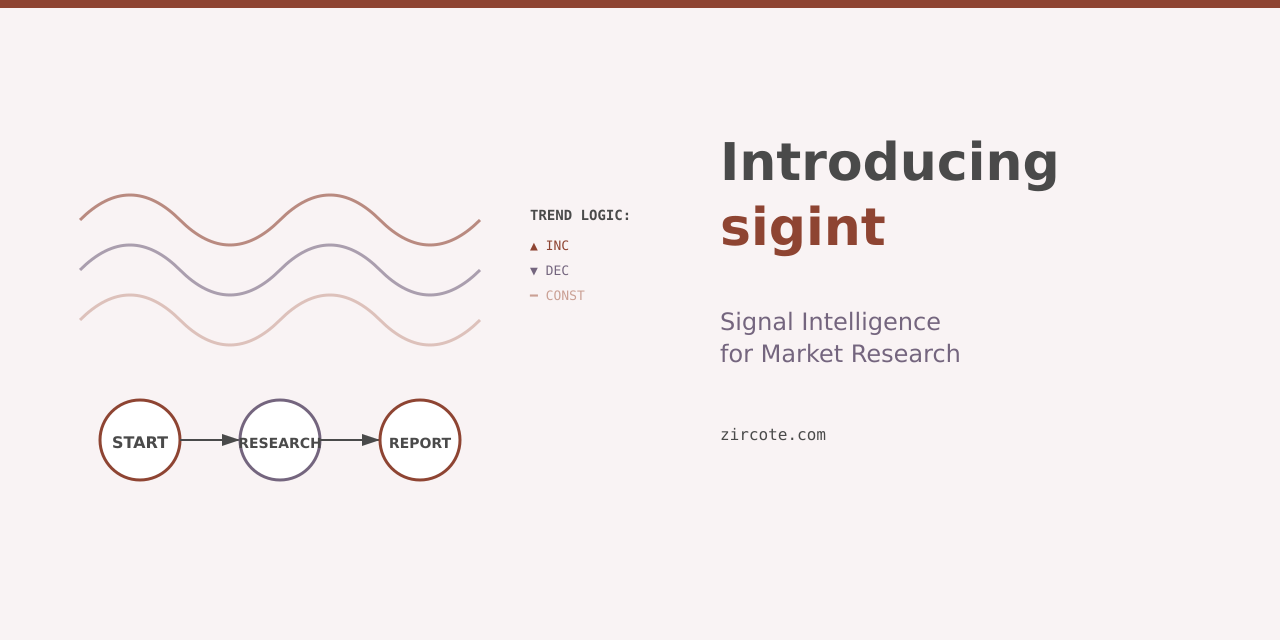
sigint implements trend modeling based on research by Bočková, Volná, and Dohnal (2025) that uses three states instead of precise values:
| State | Meaning | Example |
|---|---|---|
| INC | Increasing | “AI coding assistant adoption is growing” |
| DEC | Decreasing | “Manual code review prevalence declining” |
| CONST | Constant | “Code quality requirements remain stable” |
This approach models trends when you have directional insight but not exact measurements. You can map state transitions and reason about likely scenarios without claiming precision you don’t have.
sigint generates transitional scenario graphs showing possible futures based on trend combinations. Instead of one forecast assuming specific growth rates, you see branching paths: “If AI adoption increases AND manual review decreases, then…” versus “If both trends hold constant, then…”
This matters for early-stage decisions where exact data is impossible but directional analysis is actionable.
Commands and Workflow
The interface is command-based. Each command advances the research workflow:
# Start new research on a topic
/sigint:start serverless database options for IoT

# Deep-dive into specific aspect
/sigint:augment pricing models and unit economics

# Refresh data for existing research
/sigint:update

# Generate comprehensive report
/sigint:report

# Create GitHub issues from findings
/sigint:issues

# Resume previous session
/sigint:resume

# Check current progress
/sigint:status

# Manually initialize Subcog context
/sigint:init
A typical session looks like this:
You: /sigint:start local-first sync protocols
sigint: Asks about your decision context, target audience, budget constraints, timeline
You: Answer the questions (this guides research depth and angle)
sigint: Researches autonomously using web search tools, applies market sizing frameworks, analyzes competitors
You: /sigint:status to check progress
sigint: Shows research coverage: competitors analyzed, market data gathered, technologies assessed
You: /sigint:report
sigint: Generates markdown report with executive summary, market analysis, competitive landscape, SWOT, recommendations, data sources
You: /sigint:issues
sigint: Creates GitHub issues for next steps: “Evaluate sync protocol X”, “Prototype conflict resolution”, “Interview target users about latency tolerance”
The research persists in subcog memory. Two weeks later you can /sigint:resume and continue where you stopped.
Report Structure and Outputs
Reports include eight sections:
- Executive Summary: Three paragraphs covering opportunity, competitive landscape, recommendation
- Market Sizing: TAM/SAM/SOM calculations with methodology and assumptions
- Competitive Landscape: Key players, positioning, strengths/weaknesses
- SWOT Analysis: Strengths, weaknesses, opportunities, threats specific to your context
- Technology Assessment: Technical feasibility, implementation complexity, dependency risks
- Recommendations: Prioritized actions with rationale
- Risk Assessment: Technical, market, operational risks with mitigation strategies
- Data Sources: All sources cited with access dates
The report generates in markdown by default. HTML output available for presentations. Mermaid diagrams included for scenario graphs and architecture views.
sigint targets four audience types:
| Audience | Focus | Format |
|---|---|---|
| Executives | Strategic implications, high-level numbers | 2-page summary |
| Product Managers | Feature priorities, user needs, roadmap | Detailed analysis |
| Investors | Market opportunity, unit economics, risks | Financial focus |
| Developers | Technology choices, implementation complexity | Technical depth |
You can generate for one audience or all four. Same research, different lenses.
Skills: Teaching AND Executing
The skills directory contains nine methodologies. Each skill both teaches the framework and executes it:
- Competitive Analysis: Porter’s Five Forces application
- Market Sizing: TAM/SAM/SOM calculation methods
- Trend Analysis: Macro/micro trend identification and INC/DEC/CONST modeling
- Customer Research: Persona development, needs analysis
- Tech Assessment: Technology evaluation, feasibility scoring
- Financial Analysis: Revenue models, unit economics
- Regulatory Review: Compliance considerations
- Report Writing: Executive report best practices
- Trend Modeling: Three-valued logic, scenario graphs
When sigint needs to analyze competitors, it loads the competitive-analysis skill. The skill contains the framework definition (Porter’s Five Forces), application instructions, and examples. The AI applies the framework to your specific research topic.
This means sigint improves as new research methodologies emerge. Add a skill file with a new framework, and sigint can apply it.
GitHub Integration: From Research to Action
Research without action is procrastination. sigint converts findings into GitHub issues sized for sprints:
{
  "title": "Evaluate CRDTs for local-first sync",
  "body": "Research showed CRDTs handle conflict resolution automatically...",
  "labels": ["research", "technical-evaluation"],
  "effort": "3 days",
  "acceptance_criteria": [
    "Compare Yjs, Automerge, and custom CRDT approaches",
    "Benchmark merge performance with 1000+ operations",
    "Document memory overhead for typical document sizes"
  ]
}
Each issue includes:
- Context from the research
- Clear deliverables
- Effort estimates
- Labels for categorization
- Links back to source findings
You can create issues directly using GitHub CLI integration. sigint calls gh issue create with the generated content. Your backlog populates automatically from research insights.
Installation and Configuration
Install locally or copy to Claude’s plugin directory:
# Local development
claude --plugin-dir /path/to/sigint

# System installation
cp -r sigint ~/.claude/plugins/
Configuration lives in .claude/sigint.local.md:
---
default_repo: owner/repo
report_format: markdown
audiences:
  - executives
  - product-managers
auto_subcog: true
---

Additional context:
- Our company focuses on developer tools
- Budget constraints: pre-seed stage
- Technical stack: Node.js, PostgreSQL
This customizes behavior: which repo for issues, default report format, target audiences, automatic memory persistence.
Storage and State Management
Reports and data save to ./reports/ with this structure:
reports/
└── local-first-sync/
    ├── 2026-01-22-research.md
    ├── 2026-01-22-report.md
    ├── 2026-01-22-report.html
    └── 2026-01-22-issues.json
State persists through subcog MCP server. This means:
- Research context survives Claude Code restarts
- You can switch projects and return later
- Multiple research sessions track independently
- Historical research remains searchable
The subcog integration is what makes /sigint:resume work. Traditional MCP tools lose context between sessions. sigint preserves the full research state: questions answered, data gathered, analyses performed.
Dependencies
Three external dependencies required:
- GitHub CLI (
gh): For issue creation (optional, reports work without it) - Subcog MCP server: For state persistence (recommended, operates without it but loses resume capability)
- WebSearch/WebFetch tools: For research execution (required)
Claude Code includes WebSearch and WebFetch by default. Install subcog separately if you want persistent memory.
Practical Applications Beyond Market Research
The pattern applies beyond classical market research:
Technical decisions: Evaluate competing libraries, frameworks, or architecture patterns. Generate decision records with trade-off analysis.
Competitive intelligence: Track competitor product changes, feature releases, pricing updates. Automated monitoring with digest reports.
Due diligence: Research acquisition targets, partnership candidates, or vendor options. Structured analysis with risk assessment.
Content planning: Research topic spaces for blog posts, documentation, or technical talks. Identify gaps and opportunities.
The core capability is turning vague research needs into structured, actionable analysis through conversation rather than manual searching and writing.
What Makes This Different
Most AI research tools give you better search results. sigint gives you a complete research workflow. You don’t just get data. You get reports formatted for your audience, issues created in your backlog, and analysis that acknowledges what you don’t know rather than pretending certainty.
The three-valued logic foundation means you can model early-stage markets without claiming precision. The skills system means new research frameworks integrate as files rather than code changes. The subcog integration means context persists across sessions.
I’ve used this for evaluating developer tools before building them, researching agriculture automation markets, and technical architecture decisions. It cuts research time from hours to minutes for standard analyses. For complex research, it structures the investigation and ensures you cover standard frameworks.
Getting Started
Try this workflow:
- Install sigint in your Claude Code plugins directory
- Start a session:
/sigint:start [your topic] - Answer the elicitation questions (5-10 questions about context)
- Let it research (check
/sigint:statusperiodically) - Generate report:
/sigint:report - Review findings and refine with
/sigint:augment [specific area] - Create issues:
/sigint:issueswhen ready to act
The GitHub repository includes full documentation in docs/quick-start.md and docs/workflow-guide.md. The skills directory shows each research framework.
If you make decisions about technical directions, product strategy, or market opportunities, sigint structures your research and turns scattered investigation into documented analysis with clear next actions.
Links and Resources
- sigint GitHub Repository
- Quick Start Guide
- Workflow Guide
- Research Skills
- Three-Valued Logic Research Paper (Bočková, Volná, Dohnal, 2025)
- Subcog MCP Server (for state persistence)
Explore these capabilities, develop your roadmaps, make informed selections, know your market.
Comments will be available once Giscus is configured.