Friday Roundup - Week 8: Capital, Models, and the MCP Enterprise Shift
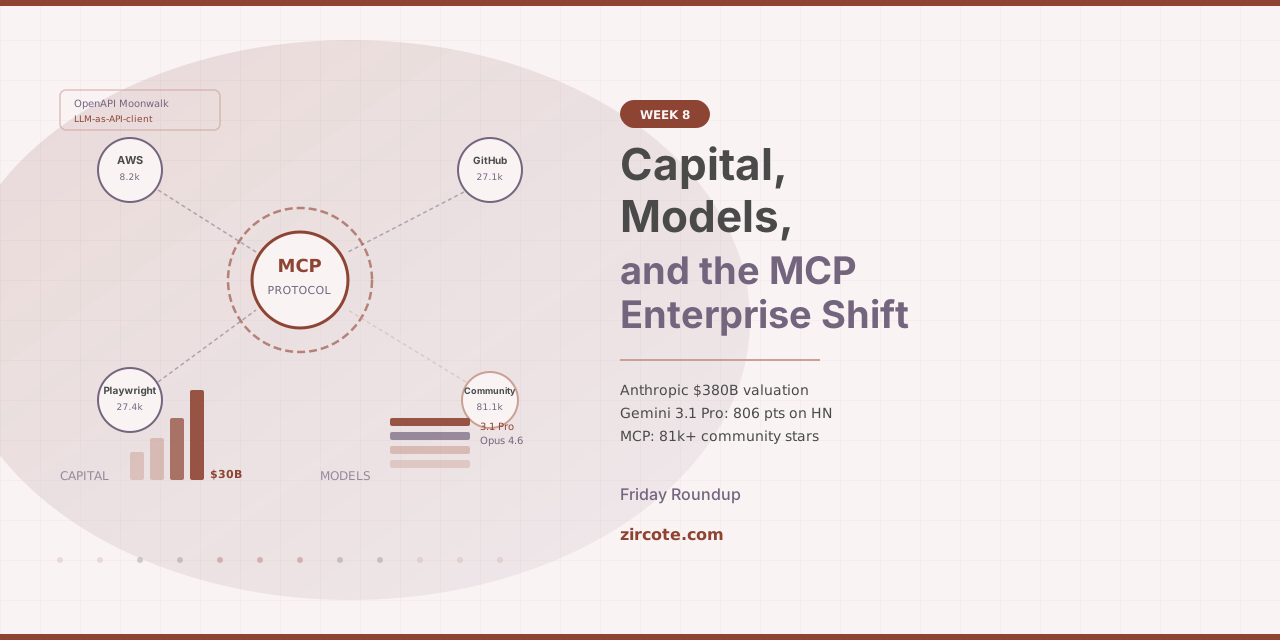
Anthropic closed a $30 billion Series G on February 12 at a $380 billion post-money valuation, reporting $14 billion in annual run-rate revenue growing over 10x each year for three consecutive years. That same week, Google shipped Gemini 3.1 Pro and the HackerNews thread hit 806 points. Both announcements landed while MCP servers from AWS, Microsoft, and GitHub crossed into what looks like permanent infrastructure territory. The money and the momentum are pointing in the same direction.
The Capital Context: Anthropic at $380B
The numbers from Anthropic’s Series G announcement are striking. $14 billion run-rate revenue growing 10x annually for three years is not a trend: it’s a compounding curve. At that rate, the next 12 months put Anthropic somewhere between $50B and $140B in ARR depending on whether growth continues or moderates.
Claude Opus 4.6, released February 5, drives much of that traction. Anthropic positions it as industry-leading across agentic coding, computer use, tool use, search, and finance. The “often by wide margin” language in the announcement is unusual for Anthropic, which typically understates comparisons. Given that enterprise coding and tool use are where the SaaS revenue lives, the timing of the funding round makes sense: the product metrics are there, the enterprise adoption is there, and the capital lets them run harder at infrastructure.
For developers building on Claude, the funding matters less than the product roadmap stability it signals. Anthropic is not going to pivot or run out of runway. The Claude API and Claude Code plugin ecosystem now have the same long-term investment thesis as AWS or Azure.
Gemini 3.1 Pro and the Frontier Model Race
Gemini 3.1 Pro went live on Vertex AI this week with a model card at deepmind.google/models/model-cards/gemini-3-1-pro and a blog post from Google that accumulated 806 upvotes on HackerNews, spawning 133 comments. The preview is available directly through Vertex AI’s model garden.
The Google AI Impact Summit 2026, running February 19, layered over the model launch with announcements about partnerships and infrastructure investments. Sundar Pichai’s opening remarks touched on AI across every vertical. The summit framing matters as context: Google is positioning Gemini 3.1 not just as a competitive model but as the backbone of a broader enterprise platform play.
Separately, Together AI published research on consistency diffusion language models achieving up to 14x faster inference with no quality degradation, scoring 137 points on HackerNews. The mechanism is interesting: consistency distillation applied to diffusion language models, collapsing multi-step sampling into fewer steps while preserving output fidelity. For anyone running inference at scale, 14x throughput with equivalent quality is not a marginal improvement. A post from taalas.com on ubiquitous AI hit 123 points arguing the 17k tokens/second regime changes what applications become feasible. The throughput argument is shifting from “fast enough” to “fast enough to change the UX entirely.”
MCP Reaches Enterprise Infrastructure
A scan of GitHub found 726 repositories with 50+ stars containing “mcp server,” led by three first-party enterprise releases: awslabs/mcp at 8.2k stars (official AWS MCP servers), microsoft/playwright-mcp at 27.4k stars (browser automation via MCP), and github/github-mcp-server at 27.1k stars.
When AWS, Microsoft, and GitHub ship production MCP servers with five-figure star counts, the protocol is no longer experimental. It is infrastructure. The punkpeye/awesome-mcp-servers directory sits at 81.1k stars.
The architectural implication for existing projects is direct. An OpenAPI spec exposed as an MCP resource becomes queryable by any MCP-capable client: Claude Desktop, Cursor, or any of the dozens of emerging IDE integrations. An ADR store accessed through MCP becomes persistent architectural context across all AI-assisted development sessions. The protocol creates a standard interface that previously required custom integration work for every tool pair.
Stripe’s engineering blog published Minions Part 2 this week, covering their one-shot end-to-end coding agents. It surfaced on HackerNews as further evidence of production agent deployment at major engineering organizations.
OpenAPI Moonwalk SIG Pivots to LLM-as-API-Client
The OpenAPI Initiative February 2026 newsletter covers two developments worth tracking. First, Overlay Specification 1.1.0 shipped with a new copy property for the Action Object, full RFC 9535 compliance for JSONPath tooling, and the ability to update primitive values directly rather than through parent objects.
Second, and more significant: the Moonwalk SIG has refocused its first half of 2026 entirely on “OpenAPI as LLM-as-API-client.” The working group is investigating what additional metadata or structural information would make OpenAPI documents “agent-ready,” covering capability discovery, intent signaling, and description optimization for LLM-based workflows. The full scope is tracked on GitHub Discussions.
This is the OpenAPI community officially acknowledging that LLMs need OpenAPI to work differently than human developers do. The questions they are posing: how do you group functionality for agents, how do you surface capabilities at the right level of abstraction, how do you write descriptions that help an LLM understand intent rather than just syntax. These are not solved problems, and the SIG is meeting weekly (Tuesdays at 1700 GMT).
For swagger-php specifically, this creates a concrete roadmap item: OpenAPI annotations that generate agent-ready documentation, not just human-readable documentation. The tooling gap is real.
swagger-php: JSON Schema Centralization
Three commits landed in swagger-php this week, all focused on internal code quality rather than breaking API changes. The most substantive was “Centralize all pure JSON Schema properties” merged February 18, which consolidates JSON Schema-specific behavior into a single location. This is architectural cleanup that makes the OpenAPI 3.1 story cleaner: the codebase now distinguishes between OpenAPI-specific properties and the JSON Schema 2020-12 subset that 3.1 incorporates.
A separate commit added the missing deepObject parameter to the Parameter attribute (merged February 10), fixing a gap where deepObject style was part of the OpenAPI 3.x spec but not surfaced through the PHP annotation interface. Small fix, real correctness improvement for developers using complex query parameter encoding.
The pattern across these commits reflects active maintenance ahead of what looks like a v6 migration cycle.
Agriculture Tech: AI Research Infrastructure Expands
The University of Texas-Arlington opened an AI-driven Smart Agriculture Research Center this week, adding to a growing list of academic institutions building dedicated precision agriculture AI programs. The center focuses on sensor integration, automated field data collection, and ML-based crop management.
John Deere announced its 2026 Startup Collaborators, its annual program that embeds early-stage companies into Deere’s R&D and go-to-market pipeline. Precision Planting showcased ArrowTube at the National Farm Machinery Show, a new product targeting seed placement accuracy.
On the dealer side, Precision Farming Dealer reported that dealers saw improved precision sales and service numbers in 2025, with on-the-job training programs credited for staffing precision ag roles that formal education pipelines have been slow to fill.
The pattern here: academic institutions are building the research infrastructure, OEMs are investing in startup pipelines, and dealers are figuring out the workforce model. The stack is assembling from all three directions.
Research Highlights
ArXiv-to-Model: A Practical Study of Scientific LM Training (2602.17288, 2 upvotes): Documents training a 1.36B-parameter scientific language model from raw arXiv LaTeX using 2xA100 GPUs across 24 experimental runs. The findings on preprocessing decisions affecting usable token volume and storage/I/O constraints rivaling compute as limiting factors are directly useful for anyone running domain-specialized training under moderate compute budgets.
Agentic LLM Feedback in In-Car Assistants (2602.15569, 5 upvotes, BMW Research Group): A controlled study of 45 participants found intermediate progress feedback from agentic assistants significantly improved perceived speed, trust, and UX while reducing task load. The preferred pattern: high transparency initially to establish trust, then progressively reducing verbosity. This has direct implications for how developer-facing AI agents should communicate during multi-step operations.
Benchmark Saturation Study (cs.AI 2602.16763): Analyzed 60 LLM benchmarks and found nearly half show saturation, with rates increasing as benchmarks age. Expert-curated benchmarks resist saturation better than crowdsourced ones. Private test sets offer no protective effect against saturation. Relevant context for interpreting model comparison claims.
StereoAdapter-2 (2602.16915): Underwater stereo depth estimation for robotics using selective state space models. Achieves 17% improvement on TartanAir-UW. The agricultural angle: underwater depth perception technology developed for marine robotics crosses over to irrigation ditch inspection, aquaculture monitoring, and subsurface drainage mapping.
Looking Ahead
The capital, the models, and the protocol adoption are converging in the same direction this week. Anthropic’s $30B round buys runway for the Claude ecosystem to deepen. MCP’s enterprise adoption by AWS, Microsoft, and GitHub means the protocol won’t be forked into incompatible variants. The OpenAPI Moonwalk SIG’s LLM-client focus means the spec will evolve toward agent-readiness rather than treating LLMs as an afterthought.
The practical question for developers building in this space: how much of your current integration work becomes infrastructure this year? Which custom tool adapters you built in 2025 become standard MCP servers in 2026?
What are you building on MCP? Are the first-party enterprise servers covering your actual use cases, or are there gaps that the community catalog hasn’t filled yet? Where does OpenAPI’s Moonwalk work intersect with what you actually need to make your APIs agent-ready?
Links
Research
- ArXiv-to-Model: Scientific LM Training - 1.36B param model from arXiv LaTeX on 2xA100s
- Agentic LLM In-Car Feedback Study - BMW Research Group on trust and verbosity
- StereoAdapter-2: Underwater Depth Estimation - underwater robotics with state space models
AI Models and Infrastructure
- Anthropic Series G: $30B at $380B valuation - $14B ARR, 10x annual growth
- Claude Opus 4.6 - released February 5
- Gemini 3.1 Pro - available on Vertex AI
- Consistency Diffusion Language Models: 14x faster - Together AI
- Path to Ubiquitous AI (17k tokens/sec)
Developer Tools
- Stripe Minions Part 2: End-to-End Coding Agents
- awesome-mcp-servers - 81k stars
- ZeroClaw: “claw done right” - Changelog News coverage
- The AI Vampire (Steve Yegge)
API Ecosystem
- OpenAPI Initiative Newsletter - February 2026 - Overlay 1.1, Moonwalk SIG
- Overlay Specification 1.1.0
- Moonwalk SIG: OpenAPI for LLMs
Agriculture Tech
- UT Arlington AI Smart Agriculture Research Center
- John Deere 2026 Startup Collaborators
- Precision Planting ArrowTube at NFMS
- Precision Farming Sales Numbers 2025
Projects
Follow @zircote for weekly roundups and deep dives on AI development, developer tools, and agriculture tech.