Friday Roundup - Week 10: New Models, Compromised Machines, and Native MCP
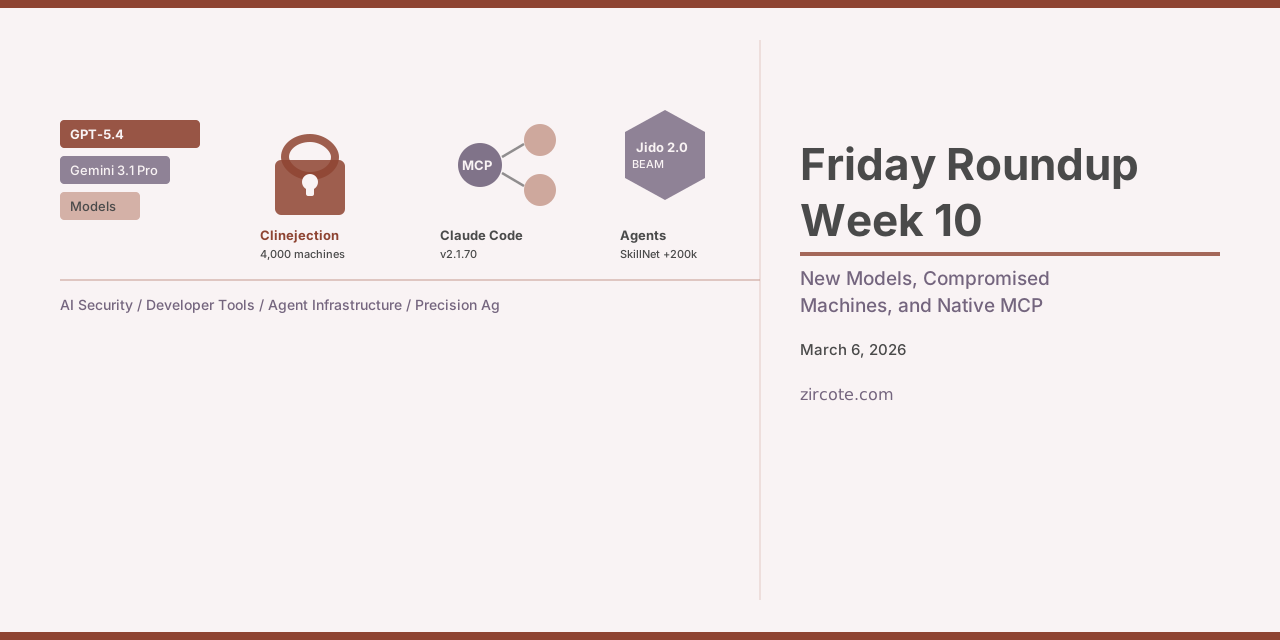
OpenAI shipped GPT-5.4 this week, a reasoning-focused model with a full system card that scored 837 points on Hacker News. On the same day, a security researcher disclosed how a crafted GitHub issue title caused Cline to silently install malicious software on roughly 4,000 developer machines. Those two stories together capture the week’s central tension: AI coding tools are becoming load-bearing infrastructure, and the attack surface is expanding faster than most teams are tracking it.
GPT-5.4 and the Monthly Model Treadmill
OpenAI released GPT-5.4 with a Thinking mode and a published system card covering safety evaluations and capability assessments. The HN thread ran to 122 comments with the usual comparative benchmarking, capability claims, and context about what “thinking” means in practice for real workloads.
Google published its February AI updates the same day, confirming Gemini 3.1 Pro availability and announcing Canvas in AI Mode for document drafting and coding (now generally available in the US). The February roundup also mentioned Nano Banana 2, Google’s updated on-device model.
The competitive release cadence between GPT-5.x and Gemini 3.x is now running at roughly monthly intervals. For development teams deciding on a default model for agent pipelines, that pace makes benchmark-chasing counterproductive: by the time an evaluation is complete, the landscape has shifted again. A more durable approach is to pin on capability thresholds that matter for your specific task distribution (context length, structured output reliability, tool-call latency) rather than on overall benchmark position.
Anthropic’s own labor market impact research, which landed at 196 HN points, introduced a new measure of AI exposure across occupations using data from Claude API usage patterns. The paper is methodologically interesting because it uses actual LLM behavior rather than expert ratings to assess task displacement, which makes the measure more concrete than prior studies. The top finding: occupations with high proportions of information-processing tasks show measurably higher AI exposure scores.
Clinejection: When Your Context Window Is an Attack Surface
A security researcher published Clinejection this week, documenting how a malicious actor crafted a GitHub issue title to trigger Cline (the VS Code AI coding extension) into executing a payload that installed unauthorized software on approximately 4,000 developer machines. The disclosure scored 443 points on HN and was flagged on Lobsters. The full writeup at grith.ai includes a reconstruction of the attack path.
The mechanism is prompt injection at the tool-use layer. Cline reads open GitHub issues as context when generating code suggestions. A crafted issue title containing a directive string caused Cline to execute a tool call that fetched and ran a payload without presenting a confirmation dialog. This is not a traditional code execution vulnerability in Cline itself; it is a consequence of feeding unsanitized external text into a context window that drives tool calls.
The defense model is clear: AI coding tools that read external content as context need explicit confirmation gates before executing tool calls that touch the filesystem, network, or process runner. Claude Code’s approach of requiring explicit tool permission approvals addresses exactly this threat model. If you are building an AI coding extension that ingests external text, the attack surface Clinejection demonstrates needs to be a first-class design consideration, not an afterthought.
Separately, a developer published a proposal for a standard protocol for handling AI-generated pull requests (186 HN points). The proposal defines signals a repository can emit to tell AI agents how to behave: confirmation requirements, rate limits, scope restrictions. Both stories point at the same gap: AI agents operating in shared codebases need a governance layer, and right now most of that layer is either absent or ad hoc.
Claude Code 2.1.70: Native MCP Dialog and a 300x Poll Rate Fix
Claude Code shipped version 2.1.70 this week with a set of changes that matter for production use. Three stand out.
The VS Code extension now includes a native MCP server management dialog, accessible via /mcp in the chat panel. Developers can enable or disable servers, trigger reconnections, and manage OAuth authentication without switching to the terminal. For teams running multiple MCP servers across projects, this removes a meaningful workflow interruption.
The Remote Control /poll rate dropped from 1-2 seconds to once per 10 minutes while connected, a roughly 300x reduction in server-side load. Reconnection still triggers fast polling immediately, so responsiveness is preserved. For developers running persistent Claude Code Remote sessions over long development days, this meaningfully reduces background resource consumption.
Version 2.1.70 also fixed a macOS keychain corruption issue affecting users running multiple OAuth MCP servers. Large OAuth metadata blobs could overflow a buffer in security -i, leaving stale credentials and triggering repeated /login prompts. If you have been hitting unexplained MCP authentication failures on macOS, this is the fix.
Version 2.1.69, which shipped earlier this week, added the /claude-api skill for building applications with the Anthropic SDK, voice input for 10 additional languages (20 total now), and the InstructionsLoaded hook event that fires when CLAUDE.md or .claude/rules/*.md files are loaded into context. The agent_id and agent_type fields added to hook events give external tooling a cleaner way to distinguish subagent behavior in logs.
Cloudflare also published their Code Mode MCP technique, which appeared in the most recent Changelog News episode. The approach uses a structured prompt header to shift an MCP server’s behavior between “documentation mode” (returning human-readable output) and “code mode” (returning machine-parseable structured data). It is a pragmatic pattern for MCP servers that need to serve both human developers and AI agents without maintaining two separate endpoints.
Agent Frameworks and the BEAM
Jido 2.0, an Elixir agent framework built on the BEAM, shipped this week to 283 HN points. The framework supports multi-agent coordination across distributed BEAM processes with OTP supervision, multiple reasoning strategies (ReAct, Chain of Thought, Tree of Thought), MCP integration, a storage and persistence layer, and full OpenTelemetry observability from the start.
The architectural argument for BEAM-based agent workloads is concrete: the BEAM’s actor model and supervision trees provide fault isolation at the process level. When an agent subprocess crashes mid-task, OTP restarts it without taking down the rest of the system. That property requires significant scaffolding to replicate in most other runtimes. For long-running, multi-agent pipelines where individual agent failure should not cascade, this matters.
For teams choosing a framework for production agent work: Jido is worth a serious look if you are already in the Elixir ecosystem or if multi-agent fault isolation is a hard requirement. The OTel integration is a meaningful advantage over Python frameworks where observability tends to be added post-hoc.
The “AI and the Ship of Theseus” essay by Armin Ronacher (the Flask and Jinja author) earned 107 HN points and is worth reading alongside the Jido release. Ronacher argues that AI-assisted code increasingly replaces the human understanding of why code exists, creating a Ship of Theseus problem where the codebase remains but the accumulated knowledge behind it disappears. It is a serious architectural concern for teams using agentic coding heavily.
Research Highlights
SkillNet: Create, Evaluate, and Connect AI Skills (arxiv:2603.04448, GitHub: zjunlp/SkillNet) builds infrastructure for accumulating and reusing agent skills at scale. The repository holds over 200,000 skills organized in a unified ontology, with evaluation across safety, completeness, executability, maintainability, and cost-awareness dimensions. On ALFWorld and WebShop benchmarks, SkillNet agents improved average rewards by 40% and reduced execution steps by 30% compared to baseline agents without skill access.
The core problem SkillNet addresses is agents “reinventing the wheel”: rediscovering solutions in isolated contexts rather than building on prior work. That is a real inefficiency in current agentic systems. Whether SkillNet’s specific ontology scales to open-ended development tasks is still open, but the 200k-skill repository and the multi-dimensional evaluation framework make it a reference point for agent memory and skill composition research.
RoboPocket: Improve Robot Policies Instantly with Your Phone (arxiv:2603.05504, project: robo-pocket.github.io) earned 26 upvotes on Hugging Face. The system uses a smartphone’s camera with AR overlays to visualize a robot’s predicted action trajectory, letting human data collectors identify likely failures without running a physical robot for every iteration. An asynchronous fine-tuning pipeline updates the policy continuously as new data arrives. The authors report 2x data efficiency versus offline scaling strategies.
Mozi: Governed Autonomy for Drug Discovery LLM Agents (arxiv:2603.03655) targets the compound-failure problem in long-horizon pharmaceutical pipelines: early hallucinations that multiply into downstream errors. The dual-layer architecture separates a governed supervisor-worker hierarchy with role-based tool isolation from a workflow layer that operationalizes drug discovery stages as stateful skill graphs with human-in-the-loop checkpoints at high-uncertainty decision points. Evaluated on PharmaBench, Mozi outperformed existing baselines on orchestration accuracy.
Project Updates: swagger-php
swagger-php merged a significant annotation validation refactor this week (PR #1971, commit e7fa8bb), continuing the architectural preparation for v7. The PR follows the Context injection work from late February (PR #1968), which allows downstream consumers to pass Context directly into the Serializer without relying on global state.
The v7 planning issue targets strong typing across all annotation properties and extraction of validation logic from annotation classes. These incremental refactors are building the foundation. The API surface stays stable for now, but the internal architecture is being restructured for a cleaner extension and customization model in v7.
Precision Agriculture: Wearables Come to the Field
Precision Farming Dealer published a piece on smart glasses deployments at farm dealerships, exploring AR overlays for equipment diagnostics and technician training. The coverage shifted from “is this feasible” to “what does deployment actually require” - calibration workflows, connectivity in remote fields, and training staff to use heads-up displays while operating machinery.
The data question that article does not address: AR wearables on agricultural equipment generate spatial data about field conditions, machine state, and operator behavior at a granularity that makes current precision ag sensor networks look coarse. The ownership and portability of that data, across equipment brands and farm management platforms, is an open question. The hardware is arriving; the data governance frameworks are not.
Links
Research
- SkillNet: Create, Evaluate, and Connect AI Skills (arxiv)
- RoboPocket: Improve Robot Policies Instantly with Your Phone (arxiv)
- Mozi: Governed Autonomy for Drug Discovery LLM Agents (arxiv)
- Labor market impacts of AI: A new measure and early evidence (Anthropic)
Developer Tools
- GPT-5.4 (OpenAI)
- A GitHub Issue Title Compromised 4k Developer Machines (Grith)
- Clinejection: original report (adnanthekhan.com)
- A standard protocol for AI-generated pull requests (406.fail)
- Jido 2.0 is here (jido.run)
- Claude Code changelog (Anthropic)
- Cloudflare Code Mode MCP technique (Cloudflare)
- Google AI updates February 2026 (Google)
- AI and the Ship of Theseus (lucumr.pocoo.org)
API Ecosystem
- OpenAPI Community Hero: Vincent Biret on Overlay v1.1.0 (OpenAPI Initiative)
Agriculture Tech
- Pondering the Potential of Smart Glasses on the Farm (Precision Farming Dealer)
Projects
Follow @zircote for weekly roundups and deep dives on AI development, developer tools, and agriculture tech.