Friday Roundup - Week 12: Astral Goes to OpenAI, Channels Land in Claude Code
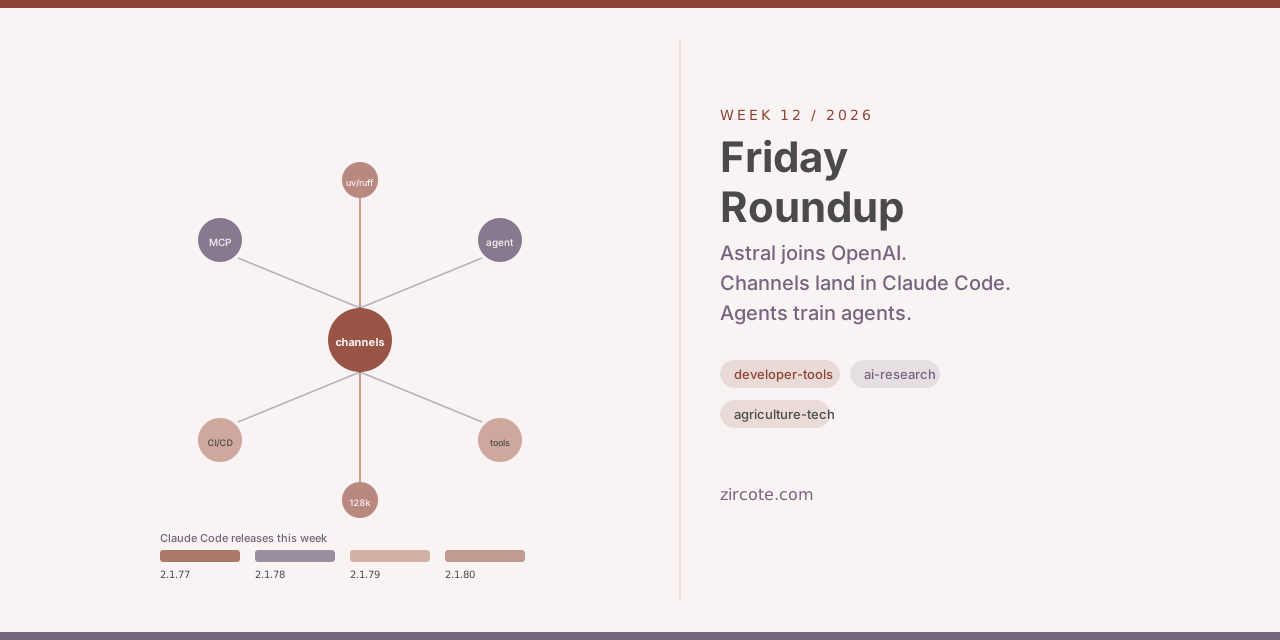
Astral, the team behind uv and ruff, announced this week that it is joining OpenAI. That acquisition reshapes the Python tooling market in ways that will play out for years. Simultaneously, Claude Code shipped four releases in three days, the biggest of which delivers MCP push channels: a research preview that lets external systems inject messages directly into running sessions. Both stories point at the same underlying shift: AI tooling infrastructure is consolidating, and the pace is accelerating.
Astral Joins OpenAI: What the uv/ruff Acquisition Means
The announcement landed Tuesday and immediately became the most-discussed developer story of the week on Hacker News, reaching a score above 1,300 with 841 comments. Astral built two tools that moved faster than anything the Python ecosystem had seen in years: ruff, a Python linter that replaced flake8, isort, pycodestyle, and dozens of plugins in a single Rust binary, and uv, a package manager that handles pip, virtualenv, and pipx workflows in one command with dramatically faster resolution times.
The practical question for teams that have standardized on these tools: Astral has committed to keeping both open source. The OpenAI integration angle is obvious: Python is the primary language for AI/ML work, and controlling the toolchain for that ecosystem has strategic value that goes beyond any individual product line. ruff already runs in VS Code extensions, CI pipelines, and pre-commit hooks across a substantial fraction of active Python projects. uv has replaced pip in many production build systems.
What changes operationally is less clear. Astral’s development velocity was already fast. Whether it accelerates under OpenAI’s resources or slows as priorities shift to internal toolchain work is the open question. For now, the existing tools work, updates continue, and the community is watching.
Claude Code Week: Channels, Remote Control, and 128k Context
Claude Code shipped versions 2.1.77 through 2.1.80 between March 17 and March 19, the densest release cadence the project has had. The channels feature landed in 2.1.80 as a research preview and generated 335 upvotes on HN within hours of the announcement.
The mechanic: external processes can now push messages directly into a running Claude Code session using --channels. The feature targets CI/CD pipelines, monitoring systems, and MCP servers that need to surface information into an active session without the user manually switching context. A deployment that fails, a linter that finds an error, or an MCP server watching a log stream can now inject that signal directly. This is architecturally different from the model reading tool output: it is reactive messaging, not a query-response loop.
Version 2.1.77 raised the maximum output token limit for Claude Opus 4.6 from the previous ceiling to 64k, and set a 128k upper bound for both Opus 4.6 and Sonnet 4.6. For context-heavy tasks like analyzing large codebases or generating lengthy documentation, this matters in practice. The previous limits were a genuine constraint on what was possible in a single turn.
The 2.1.79 VSCode release added /remote-control, which bridges an active Claude Code session to claude.ai/code in a browser or on a phone. Sessions now also receive AI-generated titles based on the first message, which makes the session history actually navigable. The 2.1.80 release also saves approximately 80MB of startup memory in large repositories with 250k or more files, a meaningful improvement for monorepo users.
Security fixes continued in this release batch. Version 2.1.77 fixed a PreToolUse hook that could bypass deny permission rules, including enterprise managed settings, when hooks returned "allow". It also fixed .git, .claude, and other protected directories being writable without a prompt in bypassPermissions mode, and added a visible startup warning when sandbox.enabled: true is set but sandbox dependencies are missing. The prior behavior was silent: users configured security and received no indication it was not active.
Agent Infrastructure: RL Training at Scale
Two papers and one open-source release address the practical problem of training multi-turn LLM agents using reinforcement learning.
NVIDIA’s ProRL Agent (arxiv:2603.18815) provides what amounts to a training-time separation of concerns: rollout orchestration runs via a standardized API, decoupled from the training loop. The system serves the full agentic rollout lifecycle, provides sandbox environments for software engineering, math, STEM, and coding tasks, and is available as part of NVIDIA NeMo Gym. For teams that want to apply RL to multi-turn agents without rebuilding the scaffolding from scratch, this closes a gap that required substantial custom engineering.
Memento-Skills (arxiv:2603.18743, 17 upvotes) from University College London takes the agent-designing-agents approach: a generalist LLM autonomously builds task-specific agents, stores reusable skills as structured markdown files, and applies memory-based reinforcement learning with stateful prompts. The results are significant: 26.2% relative accuracy improvement on GAIA and 116.2% relative improvement on Humanity’s Last Exam, without updating LLM weights. The markdown-as-skill-storage approach is particularly interesting because it makes the learned capabilities human-readable and editable rather than locked inside gradient updates.
The practical implication for anyone building production agent systems: the infrastructure for training agents is maturing faster than the consensus on what these agents should do. Teams that have been waiting for stable training tooling have less reason to wait.
On-Device AI: KittenTTS and Real-Time Robot Control
Two separate developments this week push the frontier of what runs locally without cloud infrastructure.
KittenTTS (GitHub) released three new models: 80M, 40M, and 14M parameters. The 14M variant fits under 25MB and achieves state-of-the-art expressivity among similarly sized models. All three use ONNX for runtime, are quantized to int8 and fp16, and run without GPU on hardware as constrained as a Raspberry Pi or a low-end smartphone. The eight-voice English TTS release targets the class of applications where cloud latency or cost is unacceptable: wearables, embedded systems, offline field tools. The agriculture angle is direct: equipment monitoring and field applications that operate in low-connectivity conditions need inference that works without a network connection.
FASTER (arxiv:2603.19199, 31 upvotes, University of Hong Kong) addresses latency in Vision-Language-Action models for real-time robot control. A Horizon-Aware Schedule compresses the denoising process for immediate reactions by 10x into a single step while maintaining long-horizon trajectory quality. Validation on table tennis and robot manipulation tasks shows this works in conditions where millisecond-level response time matters. VLA models have been the right architecture for complex robot tasks but the wrong architecture for real-time control loops; FASTER narrows that gap.
Agricultural Data Governance: The Farm Bill Enters the Discussion
The 2026 Farm Bill has introduced data provisions that sharpen a debate that was already running before any specific legislation. The core question: who controls the data generated by precision farming technology operating on a farm?
The Agricultural Interoperability Network (AgIN) is scheduled for initial release in 2026 and creates standardized data gateways connecting equipment manufacturers, data hubs, farm management systems, and service providers. The technical infrastructure is genuinely useful. The policy gap is that contract terms governing data collected across this infrastructure were written before AI inference at scale was operationally relevant. Machine telemetry, agronomic records, service history, and finance data each look unremarkable in isolation. Run through an AI system with cross-brand interoperable access, they enable predictive models for equipment failure, optimal service timing, and purchase behavior that neither farmers nor service providers explicitly consented to provide.
This week also brought two other agriculture signals. USDA has reversed course on regenerative agriculture, committing $700 million to programs it previously resisted, according to No-Till Farmer. Agricultural automation control systems are projected to reach $9 billion in market size by 2030 per Yahoo Finance, driven by edge computing and low-power IoT improvements that make scalable deployment viable outside of large operations.
The USDA staffing picture remains a compounding factor: loss of roughly 24,000 workers has reduced FSA capacity for loans, conservation programs, and disaster assistance. Farmers are accordingly more dependent on data-sharing arrangements with technology vendors as the institutional backstop weakens. The Farm Bill data provisions land in that context.
AutoResearch Pattern for Claude Code Skills
Alongside the Claude Code tooling activity this week, I shipped autoresearch: an autonomous skill improvement loop for Claude Code plugins, built on the pattern Andrej Karpathy described in his autoresearch talk. The mechanic is straightforward: modify a skill, evaluate it against defined criteria, keep it if it improves, discard it if it regresses, and repeat until the quality converges. The loop runs without manual checkpoints.
The motivation is practical. Writing a Claude Code skill is fast; knowing whether the skill actually works well across a range of inputs takes longer. The autoresearch loop automates that evaluation cycle: you define what “better” means, and the loop iterates. The result is eval-driven skill development where the bottleneck is the evaluation criteria, not the iteration count.
This is also the start of something broader. I am now experimenting with applying this improvement pattern across a wider set of tools, not just standalone skills. The zircote/refactor plugin, which uses four AI agents running in parallel on architecture, tests, implementation, and simplification tasks, is becoming the first plugin in what I am treating as a unified namespace for my most-used Claude Code tools. The goal is a single installable collection that groups these tools under zircote/refactor as the anchor, rather than a set of disconnected repositories.
The autoresearch loop applies directly to this: as the collection grows, each new skill or agent configuration can be evaluated automatically before it ships. The pattern scales to a plugin namespace the same way it scales to a single skill file.
Research Highlights
FASTER (arxiv:2603.19199, 31 HF upvotes): Reduces VLA robot control latency by 10x for immediate reactions using a Horizon-Aware denoising schedule. Validated on table tennis. The practical path to real-time robot control with language models runs through this kind of architecture optimization rather than through faster hardware alone.
Memento-Skills (arxiv:2603.18743, 17 HF upvotes): Agents build agents, store skills as structured markdown, improve via memory-based RL. +26.2% on GAIA, +116.2% on Humanity’s Last Exam without weight updates. The code is at GitHub.
LVOmniBench (arxiv:2603.19217, 11 HF upvotes): 275 videos, 10-90 minutes long, 1,014 QA pairs for evaluating omnimodal LLM comprehension of long-form audio-visual content. Open-source models peak below 35% accuracy; Gemini 3 Pro reaches approximately 65%. The benchmark makes visible a capability gap that was previously unmeasured.
ProRL Agent (arxiv:2603.18815, NVIDIA): RL training infrastructure for multi-turn agents, decoupling rollout orchestration from training via API. Part of NVIDIA NeMo Gym, open-sourced at GitHub.
arXiv independence from Cornell (HN score 278): arXiv has declared institutional independence from Cornell University. The practical effect on the preprint ecosystem is not yet clear, but the move has implications for long-term governance and funding of the infrastructure that most of the above research passes through.
Links
Developer Tools
- zircote/autoresearch: autonomous skill improvement loop for Claude Code
- zircote/refactor: swarm-orchestrated code refactoring plugin
- Astral joins OpenAI
- Claude Code channels documentation
- Claude Code changelog
- KittenTTS on GitHub
- Cockpit: web-based graphical interface for servers
Research
- FASTER: Rethinking Real-Time Flow VLAs (arxiv:2603.19199)
- Memento-Skills: Let Agents Design Agents (arxiv:2603.18743)
- LVOmniBench (arxiv:2603.19217)
- ProRL Agent: Rollout-as-a-Service (arxiv:2603.18815)
- arXiv declares independence from Cornell
Agriculture Tech
- Agriculture is changing: how technology is creating new jobs (USA Today)
- USDA $700 Million Turn-Around on Regenerative Agriculture (No-Till Farmer)
- Agriculture Automation Control Systems: $9B by 2030 (Yahoo Finance)
- Top Smart Farming Devices: 7 Agriculture IoT Devices 2026 (Farmonaut)
API Ecosystem
Follow @zircote for weekly roundups and deep dives on AI development, developer tools, and agriculture tech.