A Walkable Tour of What I Have Been Reading
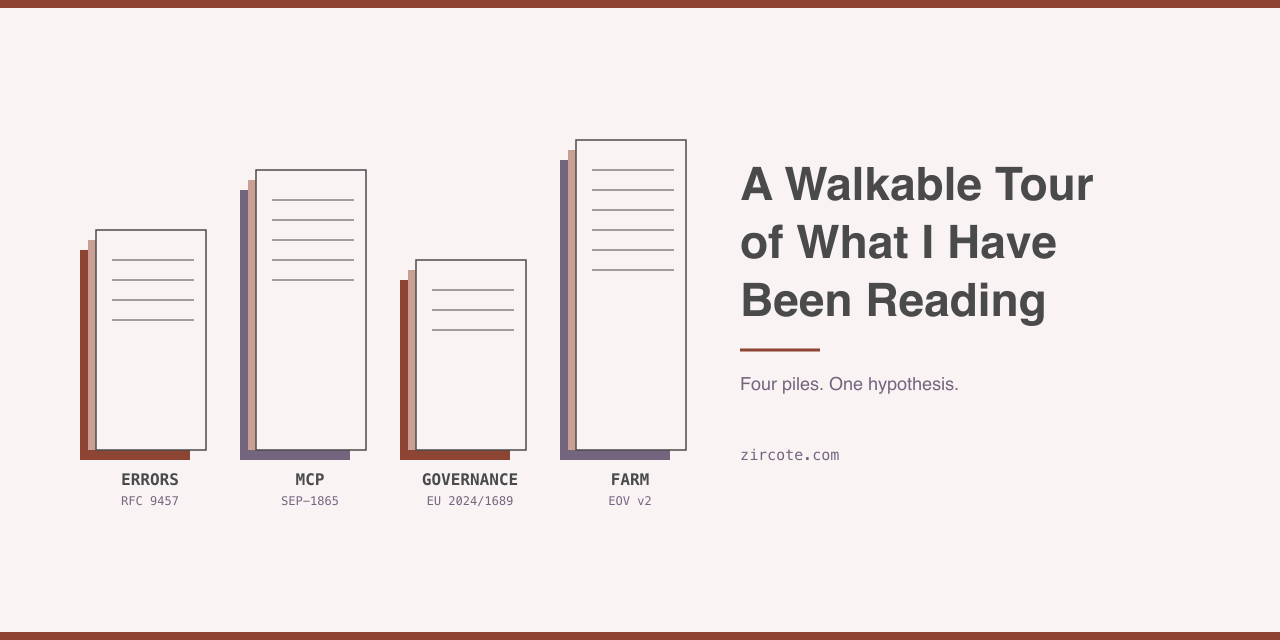
My recent reading has sorted itself into four piles. Three of the piles concern software that has to cooperate with other software (which is to say, most software written in 2026). The fourth pile concerns sheep, fences and grant paperwork. The piles are less different than they look.
A tour, then, in the order I usually find myself explaining them.
Error surfaces as agent interfaces
For most of the CLI era, an error message was a tombstone. Something broke, a human read the inscription, the human did something else. That contract is quietly dissolving. AI agents now read the same error stream, and an agent that cannot parse the tombstone cannot self-correct; it loops, burns tokens, and eventually asks a human anyway.
Two standards are doing most of the quiet work here. RFC 9457 (Problem Details for HTTP APIs, published by the IETF in July 2023) defines a machine-readable envelope for errors: a type URI, a title, a status, a detail and an instance (datatracker.ietf.org/doc/html/rfc9457). SARIF, standardized at OASIS as version 2.1.0 in 2020, does the analogous job for static analysis output (docs.oasis-open.org/sarif). Neither was designed for LLMs. Both happen to be what LLMs need: structured, parseable, labelled and boring.
Rust got there first in the ergonomics direction. The miette crate (the one that renders errors with source context and suggested fixes) is now widely imitated outside the Rust ecosystem (docs.rs/miette). The pattern worth imitating is the dual surface: a pretty rendering for the human, a structured payload for the agent, one source of truth. Tools that pick one at the expense of the other will be rewritten.
Observability has the same shape of problem one layer up. OpenTelemetry’s GenAI semantic conventions (still in experimental status as of early 2026) are the first serious attempt to give agent traces a wire protocol (opentelemetry.io/docs/specs/semconv/gen-ai). It is not finished. Multi-agent coordination, drift detection and cost attribution are still the places practitioners stitch things together by hand.
MCP as the substrate, not the feature
The vendors keep announcing new orchestrators. Temporal, LangGraph, Restate, Anthropic’s Managed Agents, the Microsoft Agent Framework that replaced AutoGen in April 2026. Each claims to be the durable execution layer the others are not. What is actually converging is the interface: structured tool calls, typed outputs and some way to pause, resume and audit.
The Model Context Protocol, Anthropic’s open specification first published in November 2024, is becoming the substrate the others compose against (modelcontextprotocol.io). It has problems. One-in-five MCP servers in the wild have been observed carrying malicious payloads, and the aws-mcp-server RCE disclosed in April 2026 as CVE-2026-5058 is the uncomfortable reference point (tenable.com/cve/CVE-2026-5058). The protocol is also the only thing every major vendor actually ships against, which is why the security story matters rather than the feature story.
The interesting architectural turn of the last quarter is channel artifacts, the pattern that lets a Claude Code plugin drive an interactive browser UI while keeping the agent loop intact (anthropic.com/engineering). The pattern solves the dual-mode interface problem (agent talks, human clicks, same session) without inventing a new transport. MCP Apps (SEP-1865, stabilized January 2026) is the more formal path toward the same end. Both are worth watching; only one has a running reference implementation.
Governance tooling reached version 1.0
Data governance is the reading I do when I want to feel older. The vocabulary has not improved much since the DAMA-DMBOK second edition (dama.org/dmbok), but the tooling has.
Two shifts deserve the attention. First, the Open Data Contract Standard reached version 3.1 in December 2025 under the Linux Foundation’s Bitol project (bitol.io). A contract specification that multiple tools can enforce is the thing the field has been missing for a decade; the datacontract-cli project hit ODCS v3.1 strict support in November 2025 (datacontract.com). Second, the OSS catalog trifecta (Databricks Unity Catalog open-sourced, Apache Polaris 1.0, Apache Gravitino 1.0) all reached production status within a twelve-month window. Federated Iceberg-REST is the resulting lingua franca.
The regulatory backdrop is less cheerful. The EU AI Act (Regulation 2024/1689) moved its general-purpose obligations into force in August 2025; high-risk obligations apply in August 2026 (eur-lex.europa.eu). California AB 2013 (training-data transparency, effective January 1 2026) and Colorado SB24-205 (effective February 1 2026) are the US analogues nobody wants to talk about. A compliance story for agent platforms is not optional after Q2 2026. It is the product.
Why the farm belongs in this list
The fourth pile is the one people assume is unrelated to the first three. It is not. The sheep paragraph is load-bearing, not decorative.
A 42-acre Katahdin operation in central Virginia is a distributed system with unreliable networking, variable sensor quality and hard real-time constraints (lambs do not wait for the software release). The reading that came out of it was more practical than the tech piles, and more useful.
Savory Institute’s Ecological Outcome Verification protocol (EOV v2, savory.global/eov) is the only grazing-outcome measurement framework with a published methodology, a certified verifier network and buyer demand from Patagonia and General Mills. The USDA NRCS Conservation Practice Standards (CPS 590 for nutrient management, CPS 528 for prescribed grazing, CPS 512 for forage and biomass planting; all catalogued at nrcs.usda.gov/resources/guides-and-instructions/conservation-practice-standards) are the counterpart on the funding side. CSP and EQIP will cover 75 to 90 percent of implementation cost for a qualifying plan. The paperwork is not the obstacle people think it is; the obstacle is matching practice standards to the farm you actually have.
On the connectivity side, the IEEE 802.11ah standard (WiFi HaLow, ratified 2017 but only recently commercialized) finally has hardware in the hundred-dollar range. Morse Micro’s WM6108 and the open-source Haven MANET build on Raspberry Pi produce a 15 Mbps symmetric mesh node at roughly $106 per point (morsemicro.com). A four-layer rural stack (Starlink uplink, HaLow mesh, LoRaWAN sensors, Meshtastic backup) now costs less than a middling used tractor. This is the part where the software piles reassert themselves. A farm with observable infrastructure is the same problem as a data platform with observable infrastructure. The sheep just care less about the tracing standard.
What the tour is actually for
The four piles share a hypothesis. Systems that survive the next five years will be the ones whose error surfaces, execution traces and data contracts are legible to software that was not in the room when the system was built. The sheep, the CLI, the agent and the auditor all need the same thing. A useful message, in a format the reader can parse, with provenance attached.
The rest is implementation detail. Worth reading anyway.
I build agentic tooling and run a 42-acre Katahdin operation in central Virginia. I write about the overlap.