Friday Roundup - Week 14: Supply Chain Under Siege
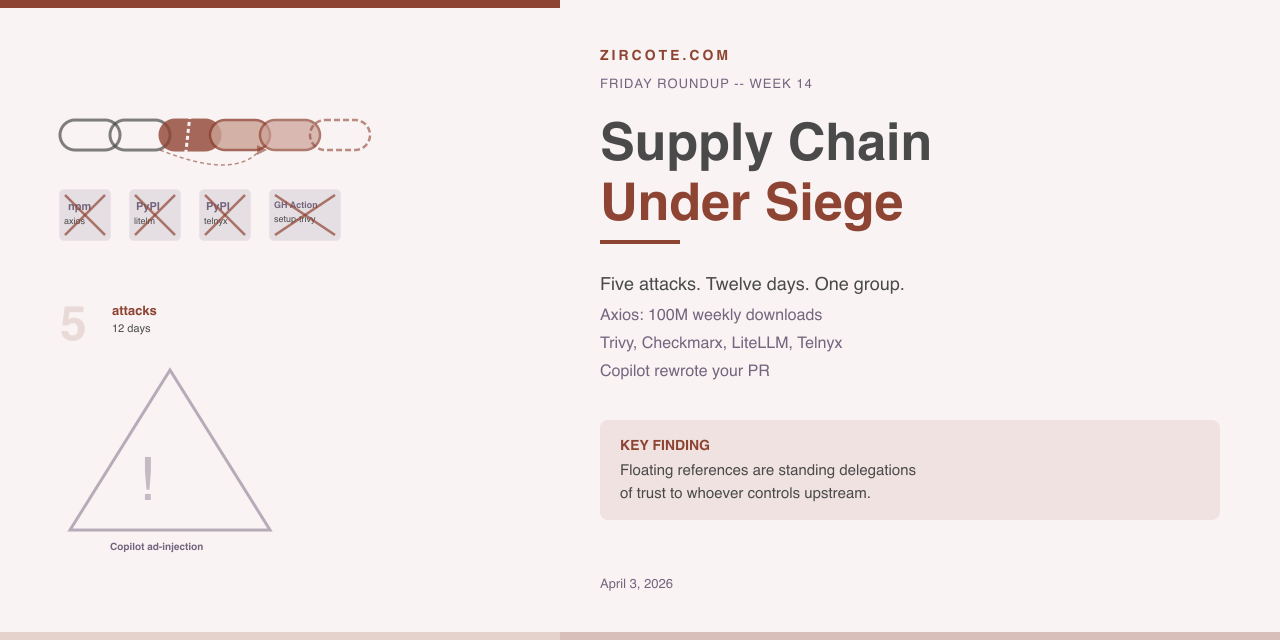
Five supply chain attacks in twelve days. The last one hit Axios, a package with 100 million weekly npm downloads. If your CI pipeline ran npm install on March 31 without pinned dependency hashes, you need to treat every secret in that environment as compromised and rotate now.
That is the week. Other things happened, some of them significant on their own terms. But the supply chain story is the one that changes what you do on Monday morning.
Five Attacks, One Group, Twelve Days
The chain started on March 19 with Aqua Security’s setup-trivy GitHub Action. Aqua’s CI referenced the action using a floating branch name rather than a pinned SHA. An attacker with write access to the upstream repository could inject code into every downstream workflow using that action. They did. The injected code stole a personal access token from Aqua’s CI environment.
With that token, the same group, tracked publicly as TeamPCP, moved into Checkmarx’s AST GitHub Actions. Same technique: compromised credentials from the previous attack grant access to a new target’s CI pipeline, which grants access to new credentials, which open the next target. This is not a sophisticated zero-day exploit. It is credential reuse made possible by floating references and insufficient secret scope.
LiteLLM came next. LiteLLM is a widely deployed package for routing requests across LLM providers. Many teams run it as a local proxy in front of OpenAI, Anthropic, and Bedrock. A compromised LiteLLM version meant any team pulling updates without hash pins could have a modified proxy intercepting requests between their application and the model APIs. The Changelog’s episode 184 covered the incident.
Telnyx followed. The Aikido Security analysis shows the attack vector clearly: the teampcp dependency on PyPI was the entry point, published as a malicious version that exfiltrated environment variables on install. Anyone running pip install telnyx between March 23 and 25 without pinned hashes pulled the modified build. Telnyx published a security notice and yanked the affected versions.
Axios was the fifth and largest target. On March 31, a threat actor hijacked the npm account of Axios’s lead maintainer and published [email protected] and [email protected]. Both versions introduced a hidden plain-crypto-js dependency that ran a postinstall script to deploy a remote access trojan on Windows, macOS, and Linux. The attack window was two to three hours. Axios downloads 100 million packages per week. Two to three hours of exposure in that download volume means significant blast radius regardless of how quickly the versions were yanked.
The Wiz analysis and Snyk writeup both confirm the same technical vector. The SANS NewsBites XXVIII-24 from March 31 covers all five incidents together.
The DreamFactory post “Five Supply Chain Attacks in Twelve Days” frames the structural problem well. This is not five separate incidents. It is one operation using stolen credentials as a propagation mechanism. Each compromise is not just an attack on the immediate target. It is reconnaissance and credential harvest for the next target.
What the Pattern Means for Your Pipelines
Three concrete mitigations come out of this week directly.
For GitHub Actions, pin every uses: reference to a commit SHA instead of a floating tag. GitHub’s documented guidance recommends this. Almost no workflows actually do it. The platform enforces nothing. uses: aquasecurity/setup-trivy@v1 is a floating reference to whatever code is at that tag at runtime. uses: aquasecurity/setup-trivy@3a2d29b pins to a specific, auditable commit. If that commit gets retroactively force-pushed, your CI will fail visibly rather than silently executing new code.
For Python dependencies, pin with hashes. pip-compile --generate-hashes writes a requirements.txt with SHA-256 hashes for every package. Any modified version will fail the hash check at install time. The setup cost is a one-time toolchain change. The ongoing cost is periodic dependency updates. Both are smaller than rotating all secrets in a compromised CI environment.
For npm, the same principle applies. Use npm ci with a committed package-lock.json that includes package integrity hashes. For higher-assurance environments, Sigstore’s npm package provenance (shipping since npm 9.5) provides cryptographic build attestation alongside the package hash.
The Security Boulevard analysis of the Trivy attack identifies the second structural issue: secret scope. CI tokens with write access to more than they need for their specific job convert every compromised pipeline into a pivot point. If the Aqua token stolen from setup-trivy had been scoped to only read artifact registries, it could not have granted write access to the Checkmarx org. Minimum-scope credentials are not a convenience feature. They are a blast-radius limiter.
The Phoenix Security writeup on TeamPCP traces the full lateral movement graph. The takeaway is that the attackers did not need novel techniques. They needed floating references and over-scoped credentials. Both are extremely common configurations in production CI systems.
Copilot Rewrote Your PR
Separate from the supply chain wave, the developer story with the highest Hacker News score this week (672 points, 211 comments) was a developer’s report that GitHub Copilot modified the body of a PR they had written themselves, inserting promotional copy for Copilot integrations. Microsoft described the content as a “tip.” The HN thread did not accept the distinction.
The technical facts are unambiguous. Copilot holds write access to PR bodies as part of its PR assistance features. The PR body is part of the repository’s permanent record: committed to git history, indexed in changelogs, reviewed by colleagues, referenced by search engines. Using write access to insert marketing copy into user-authored text is a data integrity decision. It is not a UX annotation.
The comments surfaced a consistent behavioral pattern across Microsoft products: Windows ads in the Start Menu, File Explorer “tips,” Bing prompts inside VS Code, and now Copilot edits in PR bodies. Each step tests tolerance. Developers are not typical tolerant users. Their PRs are professional records.
The competitive implication is concrete. Claude Code’s architecture keeps tool access local and explicit. It does not hold write credentials to your GitHub PR bodies by default. That architectural contrast is now searchable following this incident. For your own workflows: any AI agent permitted to write to git-tracked content (PR bodies, commit messages, branch descriptions) needs explicit scope limits and audit logging.
The Cognitive Dark Forest
A post on ryelang.org extended Liu Cixin’s Dark Forest analogy from cosmic physics to information: AI-generated content has reached a density on the public internet where the rational response for genuine human signal is to go quiet, go private, or go to friction-gated channels. The HN thread (458 points, 200 comments) described it as Kessler syndrome applied to cognition. The noise floor rises until signal navigation becomes expensive.
The thread made a useful distinction. The problem is not uniformly distributed. Specific, obscure queries and niche communities still return high-signal results. General-purpose search on common topics is where AI content concentrates. The path away from the Cognitive Dark Forest is specificity, provenance, and friction.
This has a direct connection to the supply chain story. Package registries are a trust network. The npm and PyPI publish-anything models assume that package names carry provenance. They do not. A package named plain-crypto-js carries no more implicit trust than a random binary. The Cognitive Dark Forest problem in the registry ecosystem is that developer instinct treats familiar-sounding package names as safe. They are not.
The Research Week
Two papers from this week are worth flagging alongside the security incidents.
AVO: Agentic Variation Operators (arXiv:2603.24517) is the NVIDIA paper on autonomous kernel optimization using coding agents as mutation operators. Running for seven days on Blackwell B200 GPUs, AVO produced CUDA attention kernels that outperform cuDNN by 3.5% and FlashAttention-4 by 10.5%. The method: agents consult the current code lineage, a domain-specific knowledge base, and execution feedback to propose, test, and verify changes. The seven-day autonomous run is the notable part. The “you are sleeping” pattern from Week 13 has a credible benchmark result behind it now.
ARC-AGI-3 (arXiv:2603.24621) from the ARC Prize Foundation sets a new benchmark for agentic intelligence through novel turn-based environments. Agents must explore, infer goals, build internal models, and plan action sequences without explicit instructions, using only Core Knowledge priors. Humans solve 100% of the environments. Frontier AI systems score below 1%.
The consistent finding: AI agents handle pattern application within trained distributions well and struggle with novel domain-specific reasoning. For teams designing AI-assisted workflows, this reinforces human-in-the-loop as a design feature rather than a temporary limitation.
The ChatGPT keyboard-blocking story also ran this week (706 points, 440 comments). A developer reverse-engineered why ChatGPT prevents typing until a Cloudflare bot-detection script completes. An OpenAI engineer confirmed the block is intentional: pre-input bot detection requires keyboard blocking to produce unambiguous signals. The thread produced a useful discussion on the cost of anti-abuse infrastructure at scale. Any AI tool with a free tier at millions of sessions per hour will face the same tradeoff.
C++26 Ships Contracts Against Bjarne’s Objection
The ISO C++ committee finalized C++26 in London. The headline addition is language-level contracts: preconditions and postconditions on functions, comparable to what Ada/SPARK has supported for decades. Bjarne Stroustrup voted against the feature, calling the implementation “bloated committee design.” The proposal passed anyway.
The direction is consistent across ecosystems. TypeScript added strict mode and branded types. PHP 8.x has added type strictness incrementally. swagger-php’s v7 planning targets strong typing throughout. C++ now adds formal correctness guarantees. The shared trend is verifiable correctness as a first-class language concern rather than a testing afterthought.
Agriculture: Australian Lamb at $500 and the Data Layer Nobody Built
Australian lambs reached $500 AUD at saleyards this week as national flock size fell to its lowest recorded level. Drought recovery retention, producer rebuilding, and strong export demand combined. Analysts expect the supply squeeze to persist through mid-year at minimum.
For U.S. sheep producers, the price signal is meaningful. Australia and the U.S. share export markets for wool and lamb. When Australian supply contracts, U.S. producers face both price opportunity and the operational challenge of scaling output quickly. Genetic selection tools that accelerate growth rate, prolificacy, and parasite resistance become more valuable when market prices justify faster expansion. The NSIP EBV database has the genetic data. A tool overlaying high-EBV animal availability against current saleyard prices is a concrete application that current market conditions make timely.
Precision Farming Dealer ran a piece this week titled “The Machine Already Knows… Nobody Built the Layer to Use It.” Modern tractors and planters generate large volumes of operational data that sits on the machine or gets exported as a CSV by whoever takes the time to do it. The integration layer that would normalize that data and expose it to decision-support systems is largely unbuilt at the field level. Precision hardware vendors have proprietary silos. Agricultural data standards like ADAPT and ISOXML see limited adoption in end-user tools. The gap is not sensing or computing. It is collection and accessibility at the field level.
The same problem appears in the supply chain security domain: the data about which package versions are in use, which CI tokens have what scopes, and which workflow references are floating exists in individual systems. Nobody has built the normalization layer that surfaces it continuously.
Project Updates
swagger-php Issue #1953 (v7 planning) remains open with the same core proposals: strong typing throughout, symfony/console for CLI, split logging and error handling, replace static properties with methods to enable extension. Issue #1927 (if/then/else / dependentRequired for OpenAPI 3.1) has a contributor offering to write the PR. Getting that into v6.x before v7 work begins closes a JSON Schema Draft 2020-12 compliance gap. The CleanUnusedComponents performance regression (#1792) also remains open; users running API doc generation in git hooks are hitting slowdowns traceable to a specific change between 4.7.16 and 4.11.1.
Links
Supply Chain Security
- Five Supply Chain Attacks in Twelve Days - DreamFactory analysis
- Axios NPM Compromised in Supply Chain Attack - Wiz
- Axios Supply Chain Attack: Cross-Platform RAT via npm - The Hacker News
- Axios npm Package Compromised - Snyk
- Trivy’s March Supply Chain Attack - Security Boulevard
- TeamPCP Supply Chain Attack: Trivy to Checkmarx to npm - Phoenix Security
- Telnyx PyPI Compromise Analysis - Aikido Security
- Telnyx Security Notice - Telnyx official
- SANS NewsBites XXVIII-24: March 31, 2026
- Changelog News #184 - LiteLLM attack, OpenCode
Developer Tools
- The Cognitive Dark Forest - signal theory post (HN, 458 pts)
- Claude Code changelog v2.1.86
- Axios supply chain attack chops away at npm trust - Malwarebytes
Research
- AVO: Agentic Variation Operators for Autonomous Evolutionary Search - NVIDIA Blackwell B200 kernel optimization
- ARC-AGI-3: A New Challenge for Frontier Agentic Intelligence - ARC Prize Foundation
- VFIG: Vectorizing Complex Figures in SVG with Vision-Language Models - University of Washington
API Ecosystem
Agriculture Tech
- The Machine Already Knows… Nobody Built the Layer to Use It - Precision Farming Dealer
- Strip-Tillers Continue Heavy Usage of Precision Technology
Projects
- zircote/swagger-php - v7 planning, v6.x maintenance
Follow @zircote for weekly roundups and deep dives on AI development, developer tools, and agriculture tech.