Friday Roundup - Week 19: TypeScript 10x, Agents, and Overlay
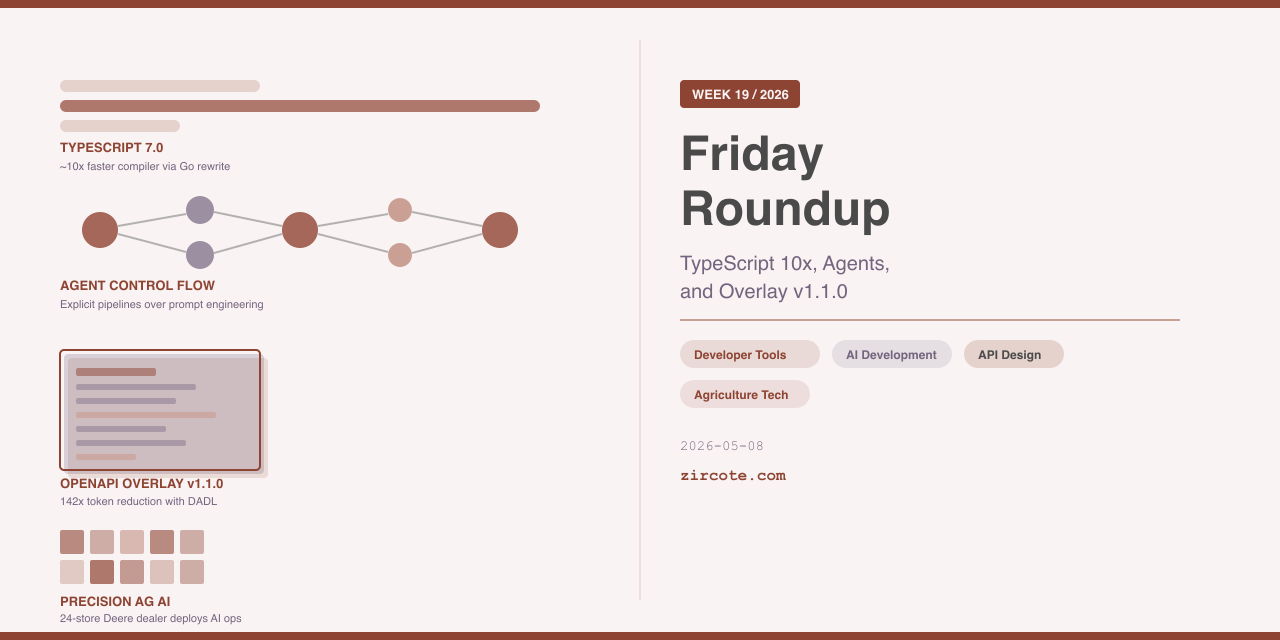
TypeScript 7.0 beta landed this week with a Go-rewritten compiler clocking approximately 10x faster builds than 6.0, supply chain attackers compromised the Bitwarden CLI through the Checkmarx campaign, and a community discussion around agentic architectures surfaced a durable observation: more prompts do not substitute for control flow. These three threads share a common concern about the reliability of developer infrastructure at scale.
TypeScript 7.0 Beta Ships a 10x Faster Compiler
The TypeScript team rewrote the compiler in Go and the Changelog News summary puts the headline figure at approximately 10x throughput improvement over TypeScript 6.0. The Go rewrite enables native binaries, eliminates the V8 startup overhead that every TypeScript CI invocation has paid historically, and reduces memory consumption significantly on large projects.
The practical consequence for teams running incremental type checking in CI pipelines is immediate: check times that once pushed a 5-minute CI budget will now compress into under 30 seconds for typical project sizes. The 7.0 beta designation means type system behavior is stable but the migration path for some edge cases in decorators and module resolution will require verification before production adoption.
This follows the broader pattern of compilers and runtimes migrating away from JavaScript self-hosting when performance constraints become acute. The Deno team moved security-critical internals to Rust; the TypeScript team moved the compiler to Go. Both decisions traded ecosystem-native tooling for predictable performance characteristics. The TypeScript 7.0 beta is available via npm at the next tag for evaluation.
Supply Chain Security: Three Incidents, One Systemic Pattern
The Bitwarden CLI compromise dominated security coverage this week. The Checkmarx supply chain campaign embedded malicious code into the Bitwarden CLI package on npm, extending a pattern that has targeted LiteLLM, httpx forks, and several smaller utilities over the past two months. The Changelog News episode 185 (published April 29, 2026) covered the Bitwarden incident alongside the more general advisory to slow software installation velocity until the campaign subsides.
The xeiaso piece titled “Maybe you shouldn’t install new software for a bit” reached 644 points on HackerNews, which reflects the community’s recognition that the advisory is directionally correct even if operationally difficult to implement. The argument is straightforward: the attack surface for supply chain compromise scales with installation frequency, and a deliberate pause on non-critical dependency updates reduces exposure without requiring any toolchain changes.
Three mitigation strategies merit attention. First, lock files committed to version control give you a fixed reference point; any dependency update that bypasses the lock file becomes auditable. Second, reproducible build tooling (Nix, Bazel, Hermit) removes the npm registry from the runtime trust chain for production builds. Third, the pgBackRest maintainer retirement, also covered by Changelog News, is a useful reminder that single-maintainer dependencies carry a different risk profile than foundation-backed projects. Auditing your dependency graph for single points of failure is worth the hour it takes.
The Dirty Frag Linux LPE vulnerability (universal local privilege escalation, published to oss-security May 7) scored 698 on HackerNews and 99 on Lobsters. It affects unpatched Linux kernels and is distinct from the supply chain campaign, but both incidents reinforce that the infrastructure layer assumed stable underneath agentic tooling requires active maintenance attention.
Agentic Search Needs Better Interfaces, Not Stronger Reasoning
A HackerNews discussion titled “Agents need control flow, not more prompts” reached 509 points this week, capturing a frustration that practitioners working with multi-step agents share. The central claim is that prompt-engineering around control flow problems scales poorly: adding retry logic, conditional branching, and error recovery to a prompt produces fragile systems, whereas encoding those behaviors in explicit control flow structures produces auditable, testable pipelines.
This observation connects directly to a paper published this week: “Beyond Semantic Similarity: Rethinking Retrieval for Agentic Search via Direct Corpus Interaction” (arxiv 2605.05242). The TIGER-Lab team shows that agents equipped with general-purpose terminal tools (grep, file reads, shell commands) outperform strong sparse and dense retrieval baselines on BRIGHT and BEIR benchmarks, without any embedding model or vector index. The GitHub repository is at DCI-Agent/DCI-Agent-Lite.
The practical implication is that the retrieval abstraction, which compresses corpus access into a single top-k similarity call, discards information that subsequent reasoning cannot recover. When an agent can interact directly with the corpus using low-level tools, it can combine weak clues, iterate over partial evidence, and apply exact lexical constraints that semantic similarity cannot express. This is not a case against vector search for all workloads; it is a case that agentic workloads require a different interface contract than batch retrieval does.
Mozilla published a related case study: “Behind the Scenes Hardening Firefox with Claude Mythos Preview” (Lobsters, score 41). The Mozilla team used Claude as an AI coding assistant to identify and patch security vulnerabilities in Firefox’s codebase. The post is a credible first-person account of where AI assistance adds value (pattern matching at scale, test case generation) and where it requires human judgment (understanding invariants, evaluating fix correctness). The tag vibecoding on Lobsters is somewhat dismissive of what appears to be a measured, production-grade application.
Anthropic published research on natural language autoencoders this week. The paper describes a method for converting Claude’s internal chain-of-thought representations into human-readable text, which reached 319 points on HackerNews. The research has implications for interpretability tooling and for auditing agentic reasoning traces in production systems.
API Tooling: Overlay v1.1.0 and the DADL Proposal
Vincent Biret of Microsoft AI Foundry contributed the primary features that became OpenAPI Overlay v1.1.0. Biret’s motivation was concrete: the Microsoft AI Foundry team uses Overlays to transform OpenAI’s approximately 300-operation API surface into TypeSpec definitions, and the prior v1.0 spec required maintaining duplicated sections that became stale weekly. The v1.1.0 additions address that duplication problem through more expressive update actions.
The OpenAPI Initiative has organized around a multi-specification model: the core OpenAPI 3.2.0 spec, Arazzo (workflow sequences), and Overlays (document transformations). The main repository has dropped from approximately 1,000 open issues to approximately 100 by routing problem areas into dedicated working groups. That structural choice has tangible benefits for implementers: each sub-specification is narrower in scope, faster to implement, and more focused in its feedback cycle.
A paper on arxiv from the cs.SE feed this week proposes DADL (Dunkel API Description Language, arxiv 2605.05247) as a declarative YAML format for enterprise tool libraries targeting LLM agents. The design observation is sharp: most MCP servers are thin wrappers around REST APIs, yet each requires a dedicated deployment with its own dependency tree. DADL consolidates 1,833 tool definitions across 20 services into a single runtime, reducing the context cost of tool advertisement from approximately 142,000 tokens to approximately 1,000. The 142x reduction changes the economics of exposing large API catalogs to agents. The v0.1 specification is released under CC BY-SA 4.0; the public registry is available from the paper.
The Gemini API now supports event-driven webhooks for long-running jobs, published to the Google AI Blog on May 4. The implementation eliminates polling for operations that require minutes to complete, which is a meaningful quality-of-life improvement for batch processing workflows built on Gemini. The webhook pattern aligns with how production integrations handle asynchronous state: push notifications are more reliable than polling under network variability.
Precision Agriculture: AI at the Dealership Tier
Precision Farming Dealer’s May 2026 coverage of “Stotz GPT” describes how a 24-store John Deere dealership has built AI and data analytics tooling into its operations infrastructure. The framing is practical: the use cases are service scheduling, parts inventory prediction, and technician routing, not autonomous field operations. The dealership tier is where precision agriculture technology reaches the majority of farmers, and tool adoption at that layer has outsized effect on overall field coverage.
A companion piece titled “What Self-Driving Cars Got Right That Your Farm Equipment Can Use” draws a direct line from automotive autonomy research to agricultural equipment guidance. The core technical transfer is the sensor fusion stack: LiDAR, camera, and GPS combined with state estimation filters that handle localization under tree canopy and GPS degradation. Automotive autonomy has invested ten years and several billion dollars solving the sensor fusion problem at scale; agricultural OEMs are now adapting those solutions to tractors and sprayers operating at 8-12 mph on variable terrain.
The convergence is worth tracking from an investment and integration perspective. Companies that built their autonomy stack on automotive-derived architectures (GPS + camera + LiDAR with tight coupling to a field management data platform) are positioned differently than those that relied solely on GNSS correction services. The market question is whether RTK correction networks alone will remain sufficient as equipment autonomy increases, or whether additional sensor layers will become table stakes.
Research Highlights
Beyond Semantic Similarity: Rethinking Retrieval for Agentic Search (arxiv 2605.05242, 5 upvotes, 2 GitHub stars). The DCI-Agent paper argues that direct corpus interaction using terminal tools outperforms vector retrieval for multi-hop and constraint-heavy agentic tasks. Practical implication: for agents that need to combine weak clues across a local corpus, grep-based search with lightweight scripting beats dense retrieval on BRIGHT and BEIR benchmarks.
KernelBench-X: A Comprehensive Benchmark for Evaluating LLM-Generated GPU Kernels (arxiv 2605.04956, 1 upvote, 14 GitHub stars). The Tsinghua team evaluates five methods across 176 kernel generation tasks and finds that task structure explains three times more variance in correctness than method choice. Quantization remains completely unsolved across all five methods. Iterative refinement improves compile rate from 52.3% to 68.8% but reduces average speedup from 1.58x to 1.44x. The finding that 46.6% of correct kernels are slower than the PyTorch baseline reframes the LLM-as-kernel-engineer narrative: correctness and efficiency are not the same problem.
DADL: Declarative API Description Language for Enterprise Tool Libraries (arxiv 2605.05247). The cs.SE paper proposes a YAML-based approach to MCP server proliferation, achieving 142x token reduction for tool catalogs at the cost of a new declarative format to learn. Worth tracking for teams managing large API surface areas for LLM agents.
Project Updates
swagger-php 6.1.2 shipped on April 28, 2026. The release addresses two issues: parameter docblock handling has been corrected (PR 1998), and PHP’s mixed type no longer emits as an invalid type: mixed in generated OpenAPI output (PR 2011). The mixed fix is particularly relevant for codebases that use PHP 8.0+ mixed type declarations; prior versions of swagger-php would produce invalid OpenAPI documents without emitting a warning.
The library also merged a change to make AbstractAnnotation::$_context non-nullable, which closes a class of null safety issues in annotation processing. Development is active and the PHP 8.6 build matrix addition from 6.1.1 confirms the library tracks upcoming PHP releases before general availability.
Links
Research
- Beyond Semantic Similarity: Rethinking Retrieval for Agentic Search via Direct Corpus Interaction (arxiv)
- KernelBench-X: A Comprehensive Benchmark for Evaluating LLM-Generated GPU Kernels (arxiv)
- DADL: A Declarative Description Language for Enterprise Tool Libraries in LLM Agent Systems (arxiv)
- Natural Language Autoencoders: Turning Claude’s Thoughts into Text (Anthropic)
Developer Tools
- Changelog News #185: Bitwarden CLI compromised, TypeScript 7.0 Beta (Changelog)
- Maybe you shouldn’t install new software for a bit (xeiaso.net)
- DeepSeek 4 Flash local inference engine for Metal (GitHub)
- Behind the Scenes Hardening Firefox with Claude Mythos Preview (Mozilla)
- jj v0.41.0 release (GitHub)
API Ecosystem
- OpenAPI Community Hero: Vincent Biret (Overlay v1.1.0 contributor) (OpenAPI Initiative)
- Reduce friction and latency with Webhooks in Gemini API (Google AI Blog)
- swagger-php 6.1.2 release (GitHub)
Agriculture Tech
- ‘Stotz GPT’: 24-Store Deere Dealer Embraces AI and Data Analytics (Precision Farming Dealer)
- What Self-Driving Cars Got Right That Your Farm Equipment Can Use (Precision Farming Dealer)
Follow @zircote for weekly roundups and deep dives on AI development, developer tools, and agriculture tech.