Friday Roundup - Week 20: OSS Strip Mining and Mythos
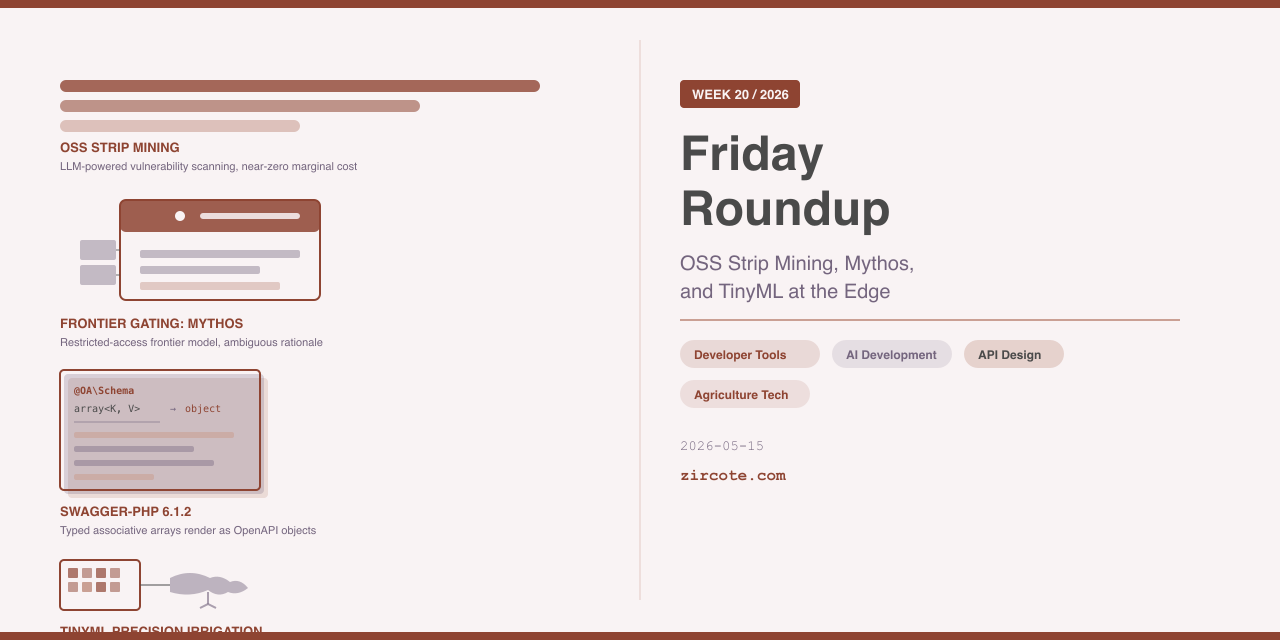
Five threads worth tracking this week. LLM-assisted vulnerability scanning of public source code crossed a practical threshold in January 2026 and is reshaping the economics of OSS security. Radicle resurfaced with a sovereign-code-forge pitch built directly on Git. Anthropic gated access to its next frontier model, “Mythos,” with rationale that alternates between safety and infrastructure cost. TinyML edge ML brought precision irrigation within reach for smallholder farms that cannot pay for cloud subscriptions. And swagger-php 6.1.2 shipped two changes that close real annotation gaps.
OSS Security: Strip Mining Hits Practical Threshold
A Metabase engineer published a piece this week arguing that the economics of open-source vulnerability discovery have shifted permanently. The core claim: bulk automated scanning of public repositories, powered by widely available large language models, became qualitatively better in January 2026. The author describes it as strip mining because the marginal cost of scanning enormous swaths of the OSS ecosystem has collapsed to near zero. HackerNews commenters noted that a year ago LLM-generated vulnerability reports were “slop, more likely a false positive than correct,” and that in recent months “nearly every LLM generated report is real.”
The practical consequence for maintainers is that the attack surface of any publicly hosted source code is now effectively continuous. Software Composition Analysis (SCA) tools that rely on CVE databases trail reality by weeks or months; the threat model has moved to real-time analysis. The HackerNews discussion is at item 48147339.
A complementary academic framing landed on arXiv this week. DEPTEX argues that existing SCA tools generate alert fatigue by treating risk as an intrinsic property of a component rather than a contextual property of how an organization actually uses that component. Reachability and usage context cut the actionable signal significantly. eDySec, a related paper, applies deep-learning dynamic analysis to detect malicious packages in PyPI. The two papers together sketch a path toward organization-first dependency risk monitoring that treats SCA output as a starting point rather than a final answer.
The market signal is clear: the gap between static SCA and runtime-aware, LLM-augmented scanning is a product opportunity. Organizations running large PHP, Python, or Node dependency graphs will pay for reduced alert fatigue combined with higher true-positive rates. Snyk, Dependabot, and Socket.dev are moving in this direction; the transition is incomplete.
Radicle: Distributed Code Forge on Git
Radicle resurfaced on HackerNews this week with its “sovereign code forge” positioning. It is local-first, peer-to-peer, and built directly on Git. The project moved domains last month (April 23, 2026). Community commentary is cautiously positive: the seeding mechanism has rough edges, but the architecture is sound. One commenter noted Radicle is “better than what GitHub is atm” for use cases requiring true data sovereignty.
The competitive dynamic is interesting. GitHub’s centralized model is deeply entrenched for public open source, but enterprise and regulated-industry customers have a genuine need for self-hosted forges that do not depend on a single vendor’s uptime or data retention policies. Radicle targets that gap. The HackerNews thread is at item 48147603.
OxCaml in Space: Zero-Overhead Abstractions in a GC Language
Jane Street’s OxCaml (an OCaml variant with stack-allocation extensions) shipped a satellite communication stack this week. The performance result deserves attention: adding exclave_ stack annotations dropped p99.9 dispatch latency from 29 ns to 9 ns per packet and eliminated GC pressure entirely. The team reported 394 minor GCs in the baseline and zero in the annotated version over 25 million packets. A community member reproduced similar results with an HTTP stack running on the same compiler.
The takeaway for developer tooling is that zero-overhead abstractions are achievable in garbage-collected languages when the type system can express allocation intent. This is structurally comparable to Rust’s borrow checker but uses a different mechanism. For teams building high-throughput API gateways or event-processing pipelines, the pattern merits a serious look. The HackerNews discussion is at item 48147058.
whichllm: Hardware-Aware Local LLM Selection
A Show HN this week introduced whichllm, a CLI that determines which local LLM runs on your hardware and ranks candidates by recent benchmarks rather than parameter count. Community feedback pointed to related tools including canirun.ai and artificialanalysis.ai. Several commenters flagged the importance of distinguishing quantizations and context-length effects on token-generation speed: 30 tokens per second can drop to 2 tokens per second at long context on some models.
The practical takeaway is that the local LLM toolchain is maturing fast enough that hardware-aware benchmarking is now a prerequisite for meaningful comparisons. Parameter count and marketing numbers are unreliable proxies. The HackerNews discussion is at item 48146369.
A maintained, commercial-grade tool that indexes current quantizations, context-length degradation curves, and batch-parallelism scaling data would fill a genuine gap. The market for hardware-aware LLM benchmarking is currently served by fragmented community projects.
Anthropic Mythos: Gated Frontier Access
Anthropic’s next frontier model, referred to as “Mythos,” is not publicly available. The company is reportedly offering access only to select large organizations. The stated rationale alternates between safety concerns and infrastructure cost. HackerNews commenters in the OSS security thread noted Mythos in the context of vulnerability scanning: one comment claims “every LLM before Mythos will have far too many false positives to be helpful” for autonomous security analysis. The author of the strip-mining article is skeptical, citing evidence that existing models with good harness design already achieve low false-positive rates.
The pattern of frontier model as gated capability is consistent with Anthropic’s prior commercial strategy. The combination with safety language creates reputational risk if the model is eventually released and shown to be commercially motivated rather than safety motivated. The HackerNews discussion is at item 48147945.
Mozilla referenced Mythos in last week’s Firefox-hardening post, so the model is reaching named partners at scale even as it remains gated for general use. That asymmetry between named-partner access and general availability is the part worth watching: it shapes which organizations get to ship with the most capable tools and which do not.
Codex Lands in ChatGPT Mobile
OpenAI shipped Codex to ChatGPT mobile this week. The announcement page sits behind a Cloudflare challenge, so the official copy is hard to read from a scripted environment, but the HackerNews front page confirms the release. Codex is OpenAI’s code-focused model; moving it into the mobile app suggests OpenAI is normalizing agentic coding assistance outside desktop IDE environments.
This is the trend line worth tracking: code agents migrating from terminals and IDEs into general-purpose chat surfaces. It pulls coding assistance toward “always available” rather than “set up a development environment first,” and that shift will reshape which audiences end up using these tools.
Multi-Agent LLM Research
Four arXiv preprints from May 2026 are worth reading.
Concurrency without Model Changes addresses a fundamental bottleneck. Tool use in LLM agents is typically sequential. The paper proposes future-based primitives that enable concurrent tool calls without modifying the underlying model, reducing latency in multi-step agentic workflows.
Toward Securing AI Agents Like Operating Systems frames the agent security problem as analogous to OS process isolation. The argument: an LLM agent handling external tool calls is structurally similar to a process executing system calls, and the same trust-boundary and capability-limiting techniques apply. The paper proposes a formal threat model for agent sandboxing. This is the academic precursor to a commercial category that does not yet exist in mature form.
Beyond Individual Intelligence surveys how multi-agent LLM systems fail and how they can self-improve. The failure-attribution section is practically useful: it categorizes how errors propagate through agent handoffs and what architectural patterns reduce error amplification.
Is Grep All You Need? argues that harness design (prompt engineering, context management, tool selection) matters more than raw model capability for many agentic search tasks. The paper is directly relevant to anyone building RAG pipelines or code-search agents. It also lines up with the Direct Corpus Interaction result from last week’s roundup, which showed terminal-tool agents outperforming dense retrieval on BRIGHT and BEIR.
ACM Queue and Claude for Legal
ACM Queue published a piece this week on the AI-native developer pattern, arguing that developer workflows are reorganizing around AI assistance at every layer rather than treating it as an add-on. The framing aligns with the thesis in The State of AI Coding Assistants in 2026 on this blog. The article lives at queue.acm.org/detail.cfm?id=3807961.
Anthropic published claude-for-legal, described as a suite of plugins for legal workflows. This is a domain-specific application of the MCP plugin pattern, analogous to the directions covered in earlier posts on MCP memory and skill references. Domain-specific plugin suites are likely the next adoption vector for MCP outside the developer-tooling pillar that has carried it so far.
swagger-php 6.1.2
Released on April 28, 2026. Two changes ship in this point release. The first corrects parameter docblock handling (PR 1998 by DerManoMann). The second maps PHP’s array<K, V> generic to OpenAPI type: object with additionalProperties (PR 2003 by krissss). The release notes are at zircote/swagger-php v6.1.2.
The array<K, V> mapping is the more significant change. PHP typed array annotations now produce correct OpenAPI object schemas rather than generic array schemas. This removes a class of manual annotation work for developers using associative arrays as structured objects. Consider a service that exposes a map of feature flags keyed by environment name; the type annotation array<string, FeatureFlag> now renders as a proper OpenAPI object with a typed additionalProperties schema, instead of an under-specified array.
Two open issues are worth watching. Issue 1953 (“v7 ideas”) is an active discussion of breaking changes for the next major version. Issue 1994 requests distinct example handling between Parameter, Media Type, and Schema objects, which reflects a common friction point when generating documentation for APIs that use polymorphic examples. OpenAPI 3.1 allows examples at multiple levels of a schema with different semantics at each level; the current PHP attribute system conflates them.
API Tooling Research
A paper on the current arXiv OpenAPI search combines Temporal Stream Logic (TSL) with LLMs to automate REST API test generation. The approach uses TSL to formally specify API behavior, then uses LLMs to synthesize test cases from the spec. This is a practical alternative to purely manual test authoring for APIs with complex stateful interactions, and the formal-specification step provides a falsifiability anchor that pure LLM test generation lacks.
The same search returned LAPIS, a Lightweight API Specification Inference System for inferring OpenAPI specs from existing API traffic. Inferred specs are inherently incomplete, but they serve as a starting point for undocumented APIs. Tooling in this category matters for organizations with legacy REST APIs that predate OpenAPI adoption.
A second paper from the same arXiv index proposes automated validation of REST API implementations against their OpenAPI specs. The academic work in this space is accelerating, which means tooling implementations are roughly 12 to 24 months behind.
TinyML for Precision Irrigation
A May 2026 arXiv paper presents an edge-first TinyML system for irrigation control targeting small-scale farming communities. The design runs entirely on constrained hardware (no cloud dependency) and addresses water scarcity and erratic climate patterns. The approach combines soil-moisture sensing with on-device inference to drive irrigation decisions without requiring connectivity.
This is the class of work that matters for smallholder farmers. Cloud-dependent precision-ag platforms require reliable connectivity and subscription fees that exclude the majority of the world’s agricultural land. Edge-first architectures that run on commodity microcontrollers close that gap. The NSIP tools posts on this blog address related themes in livestock genetics; the water-management problem is structurally similar, and the answer in both cases is to put the model where the data is generated rather than shipping data to a cloud that the farm cannot afford.
Big Data Approaches to Bovine Bioacoustics
A separate May 2026 arXiv paper presents a FAIR-compliant dataset and ML framework for precision livestock welfare monitoring using acoustic sensors. The paper addresses a data-availability problem: bioacoustic research in livestock welfare has been hampered by the absence of standardized, openly licensed datasets. The FAIR (Findable, Accessible, Interoperable, Reusable) framing signals intent to enable reproducible research rather than proprietary applications.
The convergence point is direct. IoT acoustic sensors combined with edge ML and open datasets is a viable path to welfare monitoring that does not require expensive per-animal wearables or continuous human observation. The economics work at smallholder scale, and the open-dataset framing means commodity researchers can iterate on models without re-running the data collection.
Vehicle Telemetry and Data Sovereignty in Ag Equipment
A HackerNews post (929 points, item 48138136) described removing the modem and GPS from a 2024 Toyota RAV4 hybrid. The discussion surfaced a relevant data point. A Volkswagen owner reported that despite disabling all in-app data collection settings, a Carfax request revealed the car had reported accurate mileage data within the previous five days.
The agriculture relevance is direct. John Deere, CNH Industrial, and AGCO all embed cellular modems in modern equipment that report operational data to manufacturer platforms. Farmers using precision-ag platforms are, in many cases, generating data that flows to equipment manufacturers and data brokers by default. The RAV4 discussion is a useful proxy for the regulatory and technical trajectory in ag equipment telemetry. GDPR enforcement in Europe is ahead of US regulation here, but the technical architecture is identical.
The product opportunity sits at the intersection of edge-first ML, standardized open datasets, and farmer data rights. Ag platforms that make data sovereignty a first-class feature rather than a compliance checkbox have a defensible position. The market for that positioning is small today but growing as farmers become more sensitive to where their operational data lands.
Anecdotes
The RAV4 modem-removal post has 929 comments and multiple days of front-page placement on HackerNews. The top-voted comment chain describes a Volkswagen owner who disabled every available telemetry setting and discovered their car had reported accurate odometer readings to Carfax within the past week. One reply: “System working as intended.” The grimness of that observation, delivered without editorializing, is a reasonable summary of the current state of consumer hardware data rights.
Separately: the OxCaml satellite communication stack drops p99.9 latency by roughly 69 percent and eliminates garbage collection entirely on a hot network path. The team achieved this by adding type annotations, not by rewriting in C. That result should be required reading for anyone who still believes GC languages are categorically unsuitable for low-latency systems work.
Links
Research
- DEPTEX: Organization-First Dependency Risk Monitoring (arXiv)
- eDySec: Deep Learning for Malicious PyPI Package Detection (arXiv)
- Concurrency without Model Changes: Future-based Asynchronous Function Calling for LLMs (arXiv)
- Toward Securing AI Agents Like Operating Systems (arXiv)
- Beyond Individual Intelligence: Multi-Agent LLM Survey (arXiv)
- Is Grep All You Need? How Agent Harnesses Reshape Agentic Search (arXiv)
- TinyML-Enabled IoT for Sustainable Precision Irrigation (arXiv)
- FAIR-Compliant Bovine Bioacoustics for Precision Livestock Welfare (arXiv)
Developer Tools
- The Strip Mining Era of OSS Security (HN) (HackerNews)
- Radicle: Sovereign Code Forge (HN) (HackerNews)
- OxCaml in Space (HN) (HackerNews)
- whichllm: Hardware-Aware Local LLM Selection (HN) (HackerNews)
- whichllm repository (GitHub)
- Anthropic Mythos: Restricted-Access Frontier Model (HN) (HackerNews)
API Ecosystem
- swagger-php 6.1.2 release (GitHub)
- swagger-php Issue 1953: v7 ideas (GitHub)
- swagger-php Issue 1994: distinct example handling (GitHub)
- The AI-Native Developer (ACM Queue)
- claude-for-legal (GitHub)
Agriculture Tech
- Toyota RAV4 Modem and GPS Removal (HN) (HackerNews)
Follow @zircote for weekly roundups and deep dives on AI development, developer tools, and agriculture tech.